 Barsha Heights, Tecom, Dubai
  +971 (4) 266 6763
Cracked Tooth: Can It Be Saved? Treatment Options
11/07/2026 · General Dentistry in Dubai
 11/07/2026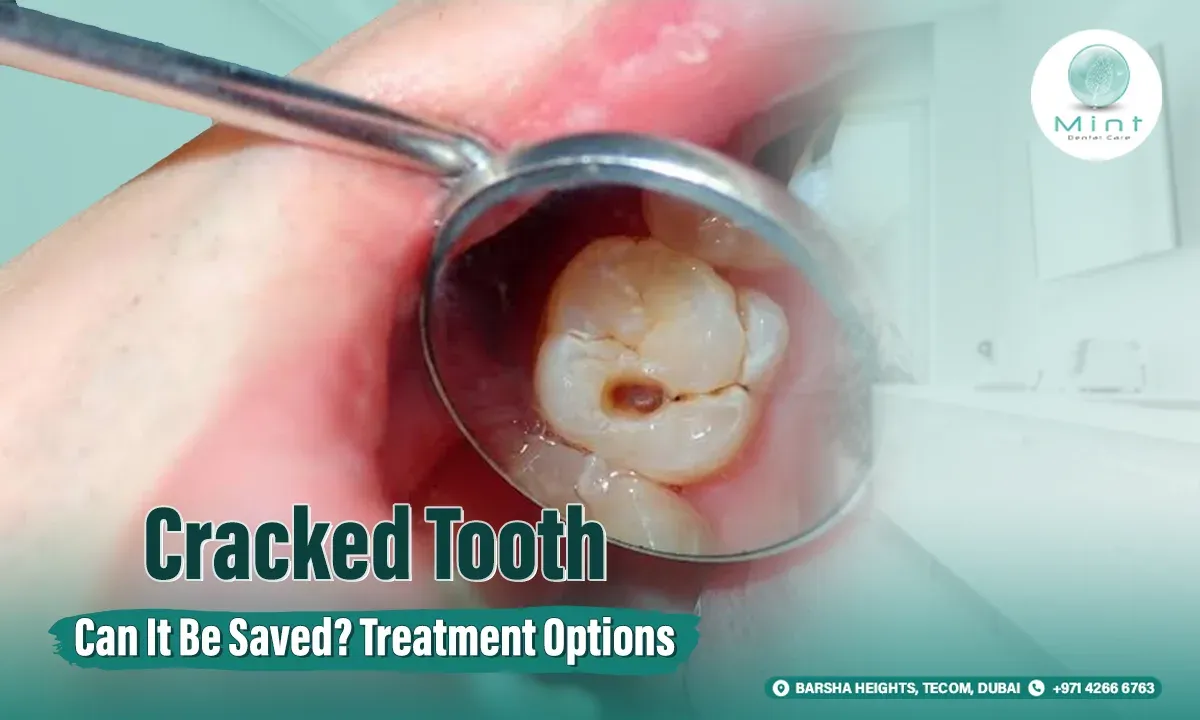
A cracked tooth can very often be saved, especially when it is treated early and the crack has not reached the root. The outcome depends on the crack’s type and depth: shallow surface cracks may need nothing, a crack into the dentine is protected with bonding or a crown, one reaching the nerve needs root canal treatment, and only a split tooth or root fracture may have to be removed.
Teeth cannot heal themselves the way skin or bone does, because enamel has no living cells to close a crack back up. That is why the damage gets worse under biting force if left alone, and why timing matters. This guide explains which cracks can be saved, how each is treated, and what to do if you have cracked a tooth today.
Worried you have cracked a tooth? The safest first step is a quick exam and X-ray. Ask us about a protective crown or bridge to restore a cracked tooth at Mint Dental Care. Call +971 4 266 6763, WhatsApp us, or book online.
Can a cracked tooth be saved?
In most cases, yes. The tooth can be saved when the crack is caught before it splits the tooth in two or travels below the gum line. Dentists and endodontists save cracked teeth every day, matching treatment to how deep the crack runs. The rule is simple: the earlier a cracked tooth is treated, the more natural tooth is kept and the better the result. Left untreated, a hairline crack tooth spreads under chewing pressure until extraction is the only option.
Two things decide whether a tooth is saveable: how far the crack has travelled, and whether it has reached the pulp (the nerve) or the root. A crack limited to the crown has an excellent outlook, while one that runs into the root or has separated the tooth into loose segments is far harder, sometimes impossible, to save.
Types of cracks in a cracked tooth
Not every crack is an emergency, and not every crack threatens the tooth. Dentists group cracks into five recognised types, and the type largely predicts the treatment and whether the tooth survives.
| Type of crack | What it is | Can it be saved? |
|---|---|---|
| Craze lines | Tiny, shallow cracks in the outer enamel only. Very common in adults and usually painless. | Yes, no treatment needed beyond cosmetic polishing. |
| Fractured cusp | A piece of the chewing surface breaks off, often around an old filling. Rarely reaches the nerve. | Yes, restored with a filling, onlay or crown. |
| Cracked tooth | A crack running from the chewing surface towards the root, but still in one piece. | Usually yes if caught early, often with a crown and sometimes root canal. |
| Split tooth | A crack left too long, now separated into distinct segments. | Rarely saved whole; sometimes one segment can be kept. |
| Vertical root fracture | A crack that starts in the root and moves upward. Often silent for a long time. | Usually not; extraction is common. |
The middle type on this scale is the true problem tooth: very saveable if treated in time, but if left it can progress to a split tooth, which cannot be kept intact.
Cracked tooth symptoms and how it is diagnosed
Cracked tooth symptoms can be frustratingly vague, which is exactly why cracks are often missed. The classic sign is a sharp, brief pain when you bite down and, more tellingly, a jab of pain when you release the bite. This on-and-off discomfort is common enough to have its own name: cracked tooth syndrome. Other typical symptoms include:
- Sharp tooth crack pain when chewing, especially on hard or fibrous foods.
- Sensitivity to hot, cold or sweet that lingers after the trigger is gone.
- Pain that comes and goes rather than a constant ache.
- Swelling of the gum around a single tooth, or discomfort you cannot quite pinpoint.
Some cracks cause no symptoms, particularly a hairline crack tooth or an early root fracture, and because the pain is intermittent even the dentist may struggle to identify the culprit. To confirm the diagnosis we combine methods: asking you to bite on a special tool to reproduce the pain, shining a light through the tooth, applying dye to make the crack visible, and taking X-rays or a 3D cone-beam scan. A deep vertical crack does not always show on a standard X-ray, so a cone-beam scan often confirms a suspected cracked molar.
Treatment for a cracked tooth by severity
There is no single fix. The right treatment is matched to how deep the crack goes and whether the nerve is involved.
| Severity | Typical treatment | Goal |
|---|---|---|
| Surface crack (enamel only) | Polishing or dental bonding | Smooth and seal a minor crack, mostly cosmetic |
| Crack into dentine, no nerve damage | Bonding, onlay or a crown for cracked tooth protection | Hold the tooth together and stop the crack spreading |
| Crack reaching the pulp | Root canal treatment, then a crown | Remove the infected nerve and reinforce the tooth |
| Split tooth or root fracture | Extraction, then implant or bridge | Remove an unsaveable tooth and restore the gap |
A crown is the workhorse here, capping the whole tooth so a crack cannot open further under bite pressure. When the crack reaches the nerve and causes deep sensitivity or an abscess, root canal treatment clears the infection first, and a crown then protects the tooth. If the crack has split the tooth or run into the root, it usually has to be removed and replaced, though a bridge or an implant restores full function afterwards.
What to do right now if you have a cracked tooth
If you have just cracked a tooth, simple steps protect it until you are seen. Rinse gently with warm salt water to keep the area clean. Hold a cold compress against your cheek to limit swelling, and take an anti-inflammatory such as ibuprofen if you have no medical reason to avoid it. Until you reach a dentist, chew on the opposite side and avoid very hot, cold, hard or sticky foods, all of which can drive the crack deeper.
Do not ignore it even if the pain settles, because a quiet crack is still spreading. If you have severe pain, bleeding, swelling or a broken-off piece, treat it as urgent and see an emergency dentist in Dubai the same day, since prompt care often makes the difference between saving and losing the tooth.
How to prevent cracks in the first place
Most cracks come from force the tooth was not built to take. You can lower your risk considerably:
- Do not chew ice, boiled sweets, pen lids or unpopped popcorn kernels.
- Wear a custom night guard if you grind or clench in your sleep, and a sports mouthguard for impact sports.
- Treat large old fillings early, as heavily filled teeth crack more easily.
- Keep up regular check-ups so tiny cracks are caught before they spread.
Our guide on how to protect your teeth from cracking and breaking covers the daily habits that keep enamel strong, and prevention is far simpler than repair after the fact.
The bottom line is reassuring: a cracked tooth is usually saveable, and the sooner it is assessed the more natural tooth you keep. The crack’s type and depth decide the path, from a simple bonding to a protective crown, a root canal, or a replacement. Do not wait and hope, because cracks only travel one way; a short exam now gives your tooth the best possible chance.
Let us assess your cracked tooth properly. Our MOHAP-licensed specialist team will examine, scan and, where needed, fit a durable crown or bridge for your cracked tooth so you can bite with confidence again. WhatsApp us, call +971 4 266 6763, or book online. Mint Dental Care, Barsha Heights (TECOM), Dubai.
Frequently asked questions
Can a cracked tooth heal on its own?
No. Unlike bone, a tooth has no way to repair a crack, because enamel contains no living cells. The damage will stay and tends to worsen under chewing, so it needs professional treatment to stop it spreading.
How do I know if my crack is serious?
Warning signs include pain when you release a bite, lingering temperature sensitivity, gum swelling around one tooth, or a visible line or missing piece. Any of these suggests the crack has moved beyond the enamel and should be seen promptly.
Will a cracked tooth always need a crown?
Not always. A shallow crack may only need bonding, and a fractured cusp can be repaired with a filling or onlay. A crown is recommended when the tooth must be held together against bite pressure, common once the crack reaches the dentine.
Is a cracked molar harder to save than a front tooth?
A cracked molar takes the heaviest chewing forces, so cracks there can deepen quickly, but molars are still very saveable when treated early. What matters is how far the crack has travelled, not the tooth position.
Can a hairline crack be left untreated if it does not hurt?
It should not be. A painless hairline crack tooth is still a structural weakness that can widen without warning, and ignoring it risks the crack reaching the nerve or splitting the tooth.
How long can you wait before treating it?
There is no safe waiting period. Because cracks only progress, every week of chewing pushes a saveable tooth closer to more extensive work. Book an assessment within a few days, sooner if there is pain or swelling.
What happens if the tooth cannot be saved?
If it is split or the root is fractured, the tooth is removed to prevent infection, then replaced. A dental implant or a bridge restores full function and appearance, so an unsaveable tooth need not mean a permanent gap.