 Barsha Heights, Tecom, Dubai
  +971 (4) 266 6763
Palatal Expander in Dubai: How Orthodontic Expanders Work
13/08/2026 · Orthodontics in Dubai
 13/08/2026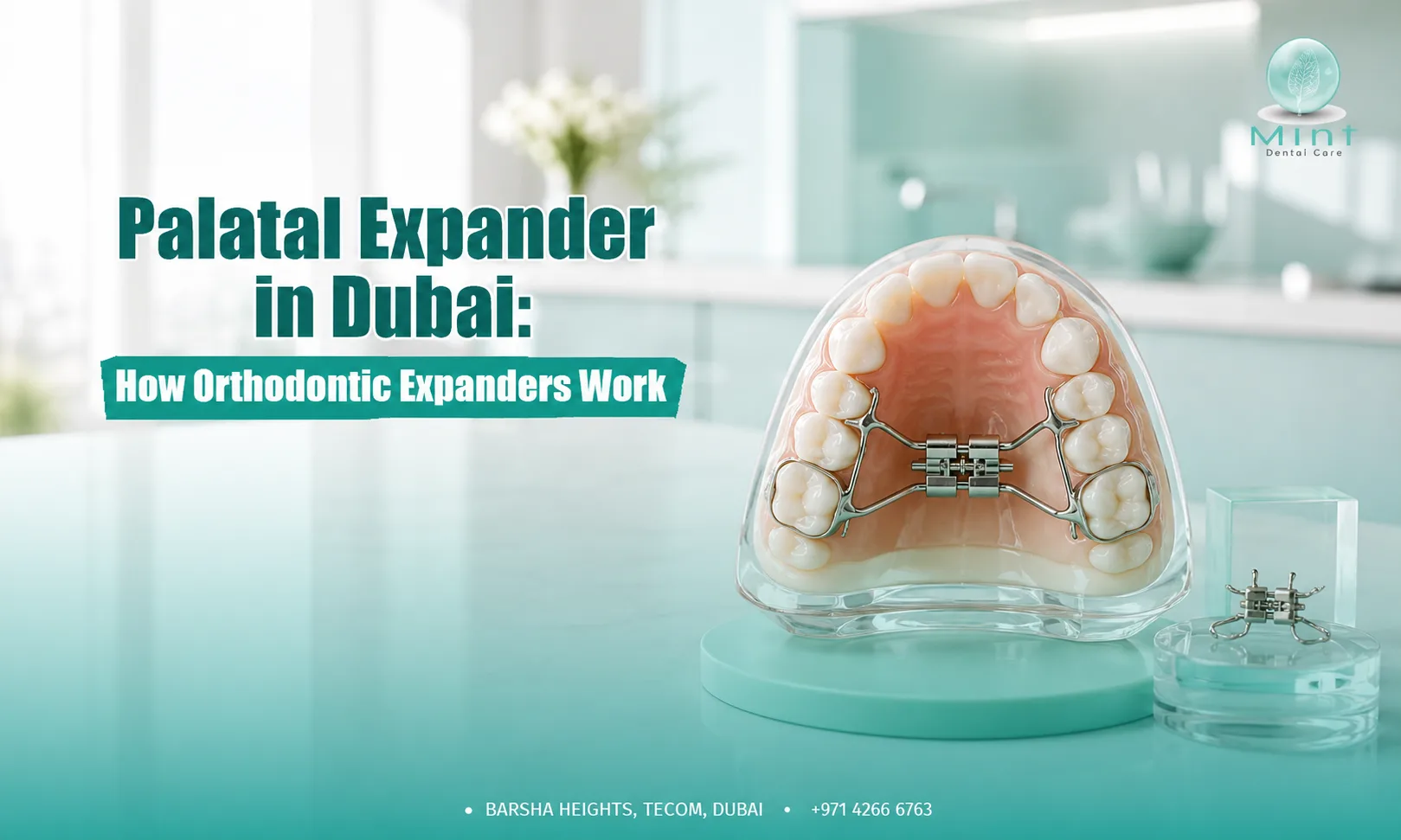
Palatal expander treatment widens a child’s upper jaw by gently separating the two halves of the palate before they fuse in the late teens. It is fitted to correct a crossbite, a narrow arch or severe crowding, it is worn for around 6 to 12 months, and it works best between the ages of 7 and 13 while the growth plate in the roof of the mouth is still open.
Parents usually hear about it at a first orthodontic check and leave with more questions than answers. This guide covers what a palatal expander actually does, the signs your child may need one, how the ages work, what the turning routine feels like, and what happens afterwards.
Wondering whether your child needs early treatment? Book an orthodontic assessment at Mint Dental Care and get a clear answer before the jaw stops growing. Call +971 4 266 6763, WhatsApp us, or read about our braces and orthodontic treatment.
What does a palatal expander do?
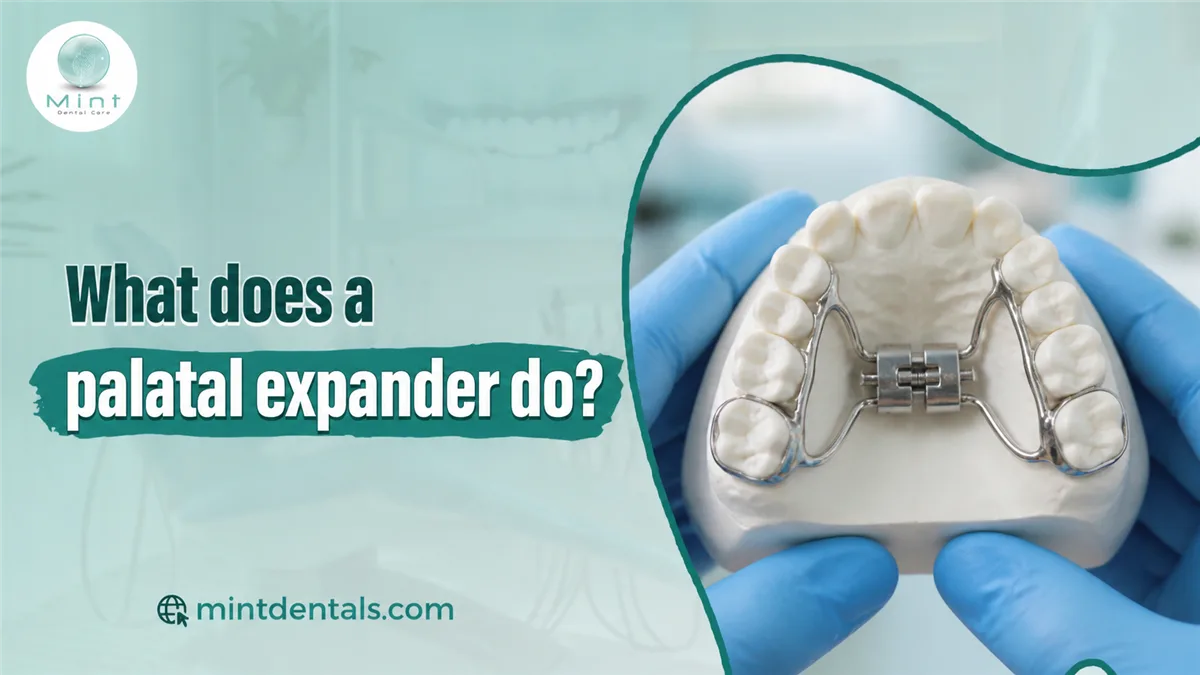
The roof of the mouth is not one solid bone in childhood. It is two halves joined by a growth line called the midpalatal suture, and that line stays open until it gradually fuses in the mid to late teens. A palatal expander sits against the upper molars and applies steady outward pressure across that suture, so the two halves separate a fraction of a millimetre at a time and new bone fills the gap behind them.
The result is a wider upper arch with genuine extra bone, not just tipped teeth. That extra width creates room for crowded teeth to come through, corrects a bite where the upper teeth close inside the lower ones, and often improves nasal airflow because the floor of the nose widens at the same time.
Signs your child may need one
- The upper back teeth bite inside the lower ones on one or both sides, which is a crossbite and the classic reason for expansion.
- The jaw shifts sideways when your child closes, so the chin looks off-centre in a full bite but straight when the mouth is slightly open.
- Adult teeth are coming through badly crowded, twisted or trapped behind the baby teeth.
- An adult canine is blocked out high in the gum with nowhere to descend into.
- Your child breathes through the mouth habitually, snores, or has a high narrow palate noticeable when they yawn.
None of these are emergencies, but all of them are easier to treat while the suture is open. Our guide to early orthodontic intervention explains which signs justify treating at seven rather than waiting for all the adult teeth.
Types of palatal expander
| Type | How it works | Typically used for |
|---|---|---|
| Rapid maxillary expander (RME), fixed | Cemented to the molars, turned daily with a key | Children 7 to 13, crossbite and crowding |
| Slow expander (quad helix) | Fixed wire that expands gradually without turning | Milder narrowing, younger children |
| Removable expander | Plate with a screw, taken out for cleaning | Small corrections, cooperative children |
| Surgically assisted expansion | Suture released surgically first | Adults, once the palate has fused |
The fixed rapid palatal expander is the workhorse of the group and the one most children in Dubai are given, because it delivers reliable skeletal width without depending on a child remembering to wear anything.
The right age, and when it is too late
Seven is the age the orthodontic profession recommends for a first assessment, and it is not arbitrary: the first adult molars and incisors are through by then, so the shape of the arch can finally be judged. A palatal expander works most predictably between 7 and 13.
From roughly 14 to 16 the suture starts to interlock, and results become less predictable, though it still often works in girls slightly earlier than boys. Once the palate has fused in adulthood, a conventional palatal expander only tips the teeth outward instead of moving bone, so genuine widening then needs a surgically assisted approach or a different treatment plan altogether. That is the honest reason orthodontists push for an early look rather than waiting.
The turning routine and what it feels like
After the palatal expander is cemented, a parent turns a small key in the central screw, usually once or twice a day for two to four weeks depending on how much width is needed. Each turn is a quarter of a millimetre, which is why the process feels like pressure rather than pain.
Expect tightness and a feeling of pressure under the nose or between the eyes for a few minutes after each turn. Speech changes for the first week and a slight lisp is normal. Eating is awkward for a few days, so soft food helps. The most reassuring sign is also the one that alarms parents most: a gap opening between the two upper front teeth. That space is proof the bone is separating as intended, and it closes on its own within a few months.
Cleaning matters because food traps around a palatal expander. Rinse after meals, brush around the bands carefully, and keep the six-monthly hygiene visits going throughout treatment.
Cost and what happens next

Expansion is normally quoted as the first phase of orthodontic treatment rather than as a standalone item, and at Mint a specialist orthodontic consultation is 300 AED, with full braces treatment ranging from 11,000 to 13,000 AED. Ask any clinic whether the quote covers the palatal expander, all the adjustment visits and the retention phase, because that is where quotes differ most.
Once the target width is reached, the palatal expander stays in place unturned for about four to six months while new bone hardens. Removing it early is the one mistake that undoes the whole result. After that many children move on to braces or aligners to align the teeth in their new, wider arch, and some need nothing further for years. Our early orthodontics for kids page sets out how the phases fit together.
The value of an early assessment is not that every child needs an appliance, because most do not. It is that the window for widening a jaw without surgery closes quietly around the mid teens, and no one gets a warning when it does. A ten-minute look at seven either finds something worth acting on or buys you years of peace of mind, and both outcomes are worth the appointment. If your child already shows a crossbite or a sideways shift when biting, that is the one finding not to postpone. Our children’s dentistry team can make the first check part of a routine visit.
Book your child’s orthodontic assessment at Mint Dental Care, Barsha Heights (TECOM), Dubai. MOHAP-licensed specialists, 4.8-star patient rating. Call +971 4 266 6763, WhatsApp us, or book online.
Frequently asked questions
How painful is a palatal expander?
It is not painful in the way braces tightening can be. Each turn produces a few minutes of pressure under the nose, and the first two or three days bring general tightness and awkward eating. Children adapt within about a week and rarely need more than simple painkillers on day one.
What is the best age for a palate expander?
Between 7 and 13, while the midpalatal suture is still open. Seven is the recommended age for a first orthodontic assessment because the adult front teeth and first molars are through and the arch shape can be judged properly.
What are the risks?
The common ones are minor: gum irritation, food trapping, a temporary lisp and tenderness after turns. Less often, an appliance loosens and needs re-cementing, or expansion relapses if it is removed before the new bone has hardened. Serious complications are rare when the case is properly selected.
Does an expander change face shape?
It widens the upper jaw, so there can be a subtle change across the base of the nose and the cheeks, and a smile that shows fewer dark corners. It does not reshape the face dramatically, and any change is generally seen as a positive one.
What age is too late for expansion?
After about 15 or 16 the suture begins to interlock and a conventional appliance tips teeth rather than moving bone. In adults, real widening needs surgically assisted expansion, so an assessment before the mid teens is the practical cut-off.
Why is a gap opening between my child’s front teeth?
That gap is expected and is the visible sign that the two halves of the palate are separating as planned. It usually closes by itself within a few months as the fibres pull the teeth back together, and any residual space is dealt with in the aligning phase.
How long is a palatal expander worn in total?
Active turning takes two to four weeks, then the appliance stays passively in place for a further four to six months while bone fills the gap. Total time with the palatal expander in the mouth is commonly 6 to 12 months.