 Barsha Heights, Tecom, Dubai
  +971 (4) 266 6763
Periodontal Flap Surgery in Dubai: Cost & Recovery
26/08/2026 · Gum Disease Treatment in Dubai
 26/08/2026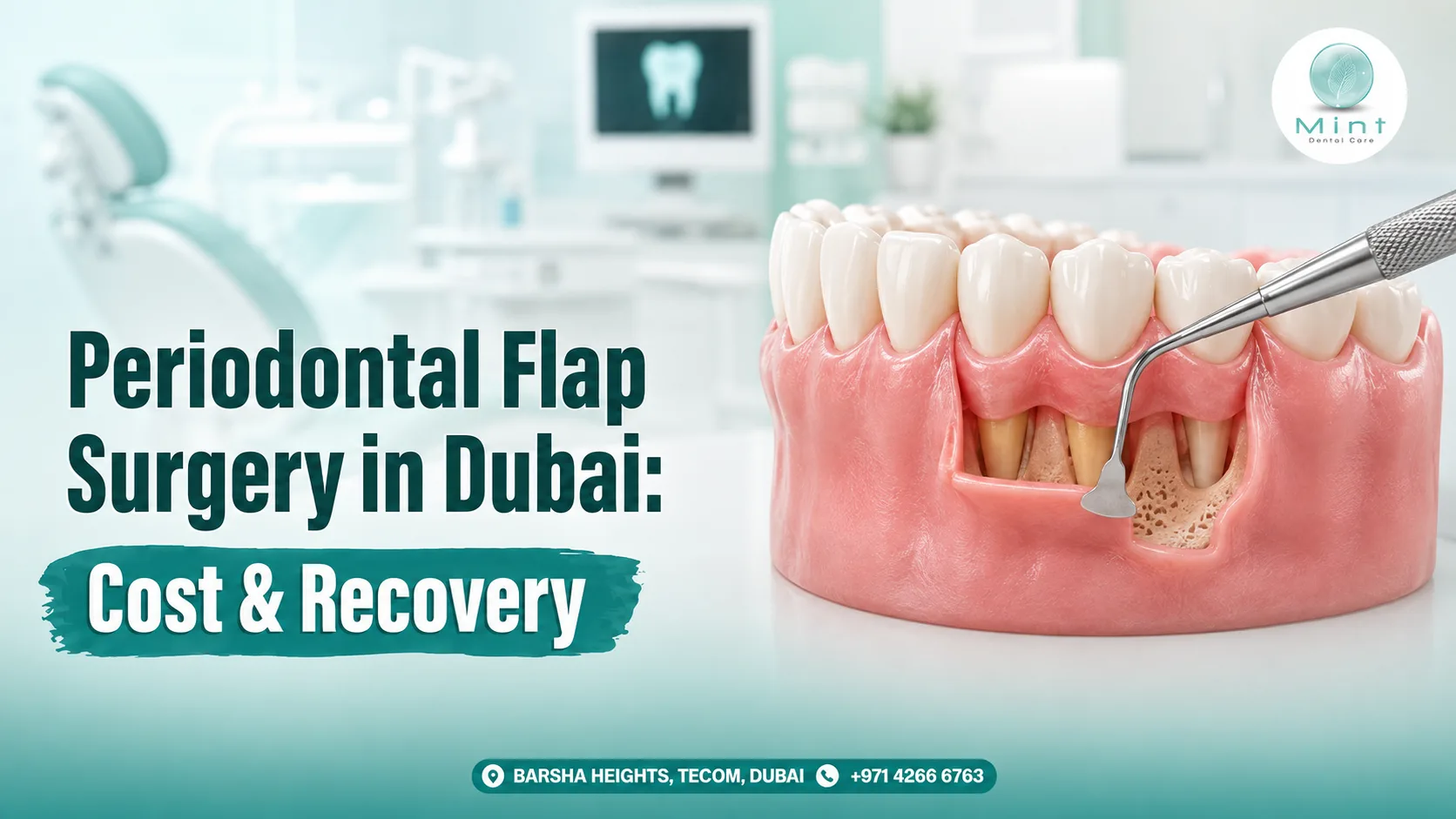
Periodontal flap surgery is the treatment for gum disease that has gone past what a deep clean can reach. The gum is lifted away from the tooth as a flap, the infected tissue and hardened deposits are removed from the root surfaces and bone underneath, then the gum is stitched back at a level that no longer leaves a deep pocket. It is done under local anaesthetic, takes 60 to 90 minutes, and the gums settle over two to four weeks.
It is recommended only when pockets stay deep after non-surgical treatment, so nobody should be scheduled straight into surgery at a first visit. Here is when it is genuinely needed, what happens on the day, and what recovery actually looks like.
Told you have deep gum pockets or bone loss? Get a periodontal assessment at Mint Dental Care before deciding on surgery. Call +971 4 266 6763, WhatsApp us, or see our gum disease treatment service.
What is periodontal flap surgery and when is it needed?
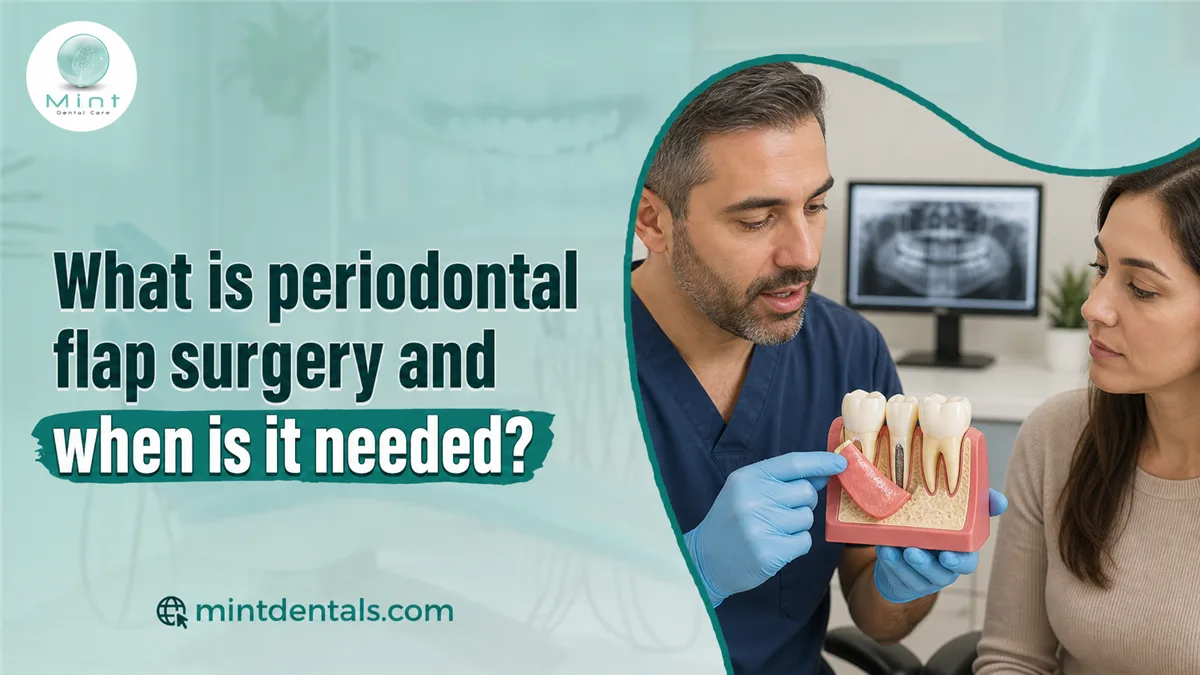
Healthy gums attach to teeth with a shallow groove of one to three millimetres. Periodontitis destroys that attachment and the bone under it, leaving pockets that fill with bacteria and cannot be cleaned by a brush, floss or an instrument passed blindly under the gum. Once a pocket passes about five to six millimetres, scaling alone stops reaching the bottom of it.
Periodontal flap surgery solves that by giving direct sight of the root. Typical indications are pockets of 6 mm or more that persist after deep cleaning, bleeding and pus that keep returning, bone craters visible on an X-ray, and teeth that are loosening because their support is being lost. It is not a treatment for bleeding gums in general, which is usually gingivitis and reverses with cleaning.
Deep cleaning first, surgery second
No responsible plan starts with a scalpel. The sequence is non-surgical therapy first: full-mouth scaling and root planing under local anaesthetic, oral hygiene coaching, and control of the things feeding the disease, above all smoking and uncontrolled diabetes.
Six to eight weeks later the pockets are re-measured. Many shrink enough to be maintained with regular cleaning and never need anything more. Periodontal flap surgery is proposed only for the sites that stay deep. Our guide to scaling and root planing explains that first phase, and it is the honest test of whether a clinic is treating you or selling to you.
What happens during periodontal flap surgery
The area is fully numbed, and sedation is available for anxious patients. A small incision frees the gum, which is lifted as a flap to expose the root surfaces and bone. Granulation tissue and calculus are cleared away, the roots are planed smooth, and where the bone has been left with craters it is either reshaped or, in selected defects, grafted with bone substitute and covered with a membrane so the body regenerates support rather than just cleaning it.
The flap is then repositioned, often slightly lower to reduce pocket depth, and secured with fine sutures. Expect 60 to 90 minutes for one quadrant. Most cases are treated a quadrant at a time so you are never eating on two surgical sites at once.
Periodontal flap surgery recovery, week by week
| Stage | What to expect | What to do |
|---|---|---|
| Days 1 to 3 | Swelling peaks, mild to moderate soreness, minor oozing | Cold packs, prescribed painkillers, soft cool food, no rinsing on day one |
| Days 4 to 7 | Discomfort fades, sutures still in place | Chlorhexidine rinse, brush everywhere except the surgical site |
| Week 2 | Sutures removed, gums look pink but tight | Restart gentle brushing at the site with a soft brush |
| Weeks 3 to 4 | Tissue matures, teeth may feel sensitive to cold | Sensitivity toothpaste, resume interdental cleaning as advised |
| Months 2 to 3 | Pockets re-measured, final result assessed | Move on to a three-monthly maintenance schedule |
Two things surprise patients afterwards, so they are worth saying in advance. Teeth often look longer, because the swollen gum that was covering the roots has shrunk back to a healthy level, and some sensitivity to cold follows for the same reason. Both are expected outcomes of periodontal flap surgery rather than complications, and our page on treating gum recession covers what can be done if the appearance bothers you later.
Periodontal flap surgery success rate, and what keeps it working
Pocket depth reduction after periodontal flap surgery is well documented and holds long term in patients who maintain it. The variable is not the surgery, it is what follows: studies consistently show that people who attend maintenance visits every three months keep their result, while those who drift back to six or twelve-monthly cleaning lose attachment again.
Smoking is the single strongest predictor of failure, both of the healing itself and of the disease returning. Diabetes control matters almost as much. If neither is addressed, periodontal flap surgery buys time rather than a cure, and any periodontist will say so before operating rather than after.
What periodontal flap surgery costs in Dubai
Fees are quoted per quadrant and depend on how many teeth are involved and whether bone grafting or a membrane is used. At Mint a specialist consultation is 300 AED, scaling and polishing is 500 AED, and the non-surgical deep cleaning phase and any surgery are quoted after the pocket chart and X-rays are done.
Ask specifically whether the quote covers the whole mouth or one quadrant, whether the three-monthly maintenance visits afterwards are included, and whether grafting materials are extra. Insurance in the UAE sometimes contributes to periodontal treatment as a basic benefit, so a written plan with codes is worth requesting for pre-approval.
The most useful thing to understand about periodontal flap surgery is that it is a repair, not a reset. It removes infection and reduces the pockets that keep it coming back, but the bone lost before treatment does not fully return, which is exactly why the earlier stages matter so much. If a dentist has told you that you have deep pockets, the productive next step is a full pocket chart and X-rays so you can see the numbers yourself, then a proper non-surgical phase, then a decision about surgery based on measurements rather than impressions. Bring your previous X-rays if you have them, since comparing bone levels over time tells us more than any single snapshot.
Book a periodontal assessment at Mint Dental Care, Barsha Heights (TECOM), Dubai. MOHAP-licensed team, 4.8-star patient rating. Call +971 4 266 6763, WhatsApp us, or book online for a full gum health check, described on our periodontist-led gum treatment page.
Frequently asked questions
How painful is periodontal flap surgery?
The procedure itself is painless because the area is fully numbed. Afterwards most patients describe soreness rather than pain for three to five days, controlled with standard painkillers. Swelling peaks on day two or three and then settles quickly.
Is periodontal flap surgery major surgery?
No. It is a minor oral surgical procedure done in the dental chair under local anaesthetic, usually one quadrant at a time, with no general anaesthetic and no hospital stay. Most people return to work the next day.
How long does it take to heal?
The surface heals in two to three weeks, sutures come out at about a week, and the gum tissue matures over one to three months. Final pocket depths are re-measured around the third month, which is when the result is judged.
What is the purpose of the surgery?
To gain direct access to root surfaces and bone that instruments cannot reach through a deep pocket, remove the infection there, reshape or regenerate damaged bone, and reposition the gum so the pocket that harboured the bacteria is no longer deep enough to do so.
What is the periodontal flap surgery success rate?
High for pocket reduction when patients keep to three-monthly maintenance and do not smoke. Long-term stability depends far more on maintenance and risk factor control than on the surgical technique itself.
Will my teeth feel loose or look longer afterwards?
Teeth can feel slightly loose for a few weeks while the tissues heal, then firm up. They usually do look longer, because swollen gum that was masking the recession has shrunk to a healthy level, and cold sensitivity often accompanies that for a while.
Can I avoid surgery altogether?
Often, if the disease is caught before pockets deepen. Non-surgical scaling and root planing resolves many cases, and it is always attempted first. Surgery is reserved for the sites that stay deep when the pockets are re-measured six to eight weeks later.