 Barsha Heights, Tecom, Dubai
 +971 (4) 266 6763
Supernumerary Teeth in Children: Why Do Extra Teeth Form?
24/10/2026 · Children's Dentistry in Dubai
 24/10/2026
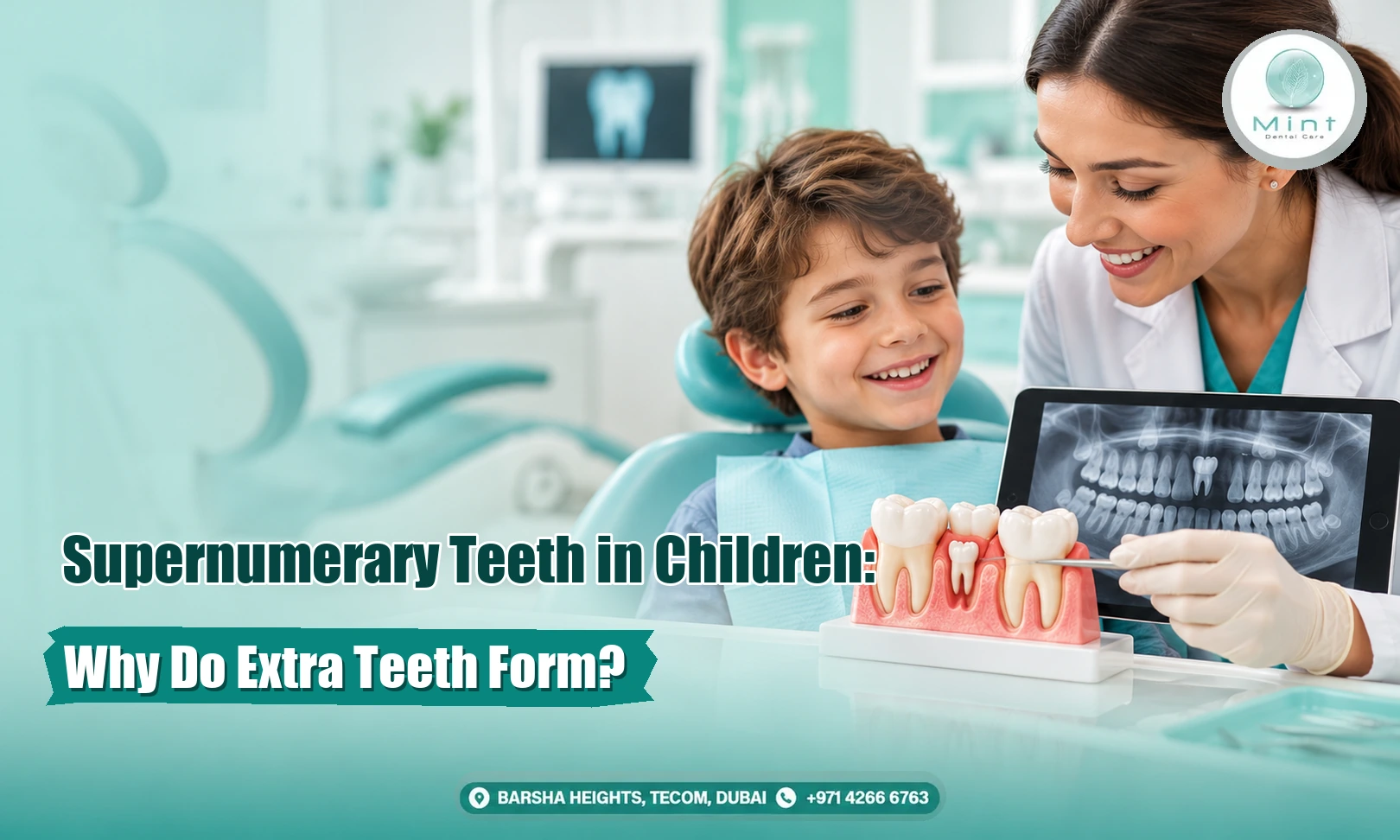
Supernumerary teeth are extra teeth beyond the normal set of 20 baby teeth or 32 adult teeth. They affect roughly 1 to 4 per cent of people, are about twice as common in boys, and most often sit between the two upper front teeth. Many never come through the gum and are found on an X-ray, usually because an adult front tooth is late to appear. Some are simply monitored; others are removed so the normal tooth can erupt.
For parents the important part is timing. Supernumerary teeth found early usually mean a short, straightforward procedure, while an extra tooth found late can leave a gap, a crowded smile or a blocked tooth that needs orthodontic help to bring down.
What supernumerary teeth are
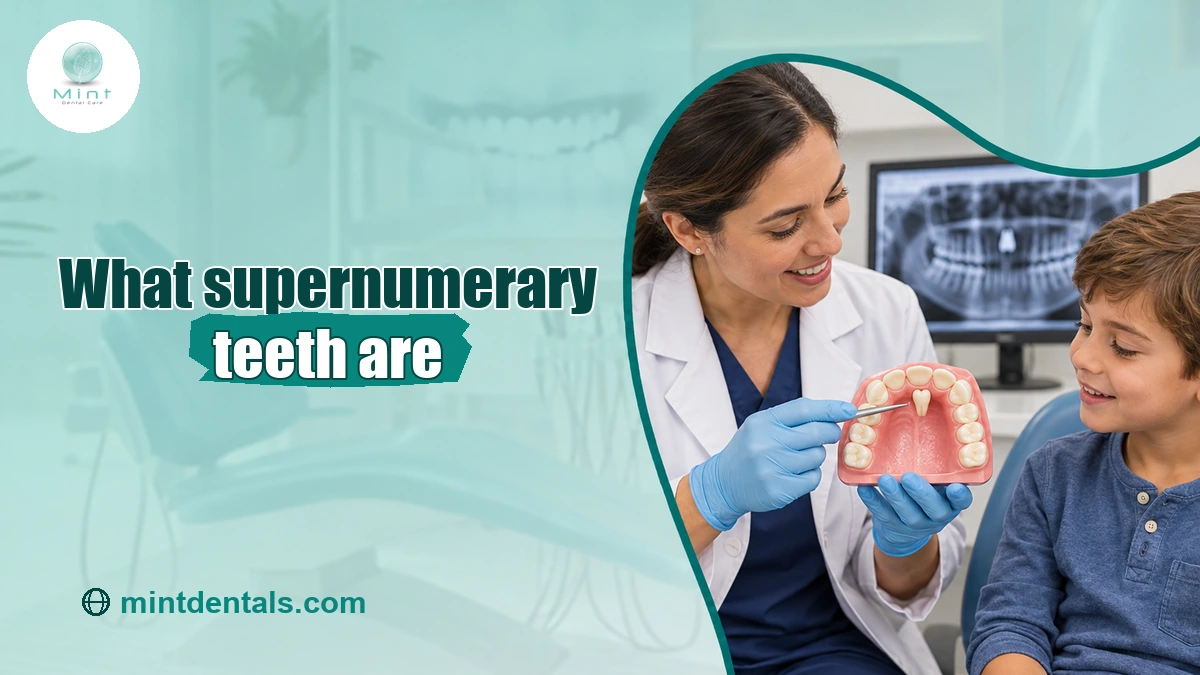
A supernumerary tooth forms from an extra tooth bud during development. It can appear in the baby teeth or the adult teeth, in either jaw, singly or in groups. Dentists also call having supernumerary teeth hyperdontia.
Conical, tuberculate and supplemental
- Conical: small and peg-shaped, the most common form. It often erupts, sometimes pointing the wrong way.
- Tuberculate: barrel-shaped with several bumps on the top. It rarely erupts and is the type most likely to block an adult incisor.
- Supplemental: a near copy of a normal tooth, most often an extra lateral incisor or premolar.
- Odontome: a small, disorganised mass of tooth tissue rather than a recognisable tooth.
How often an extra tooth appears
Studies put supernumerary teeth at around 0.3 to 0.8 per cent in baby teeth and 1 to 4 per cent in adult teeth. Roughly nine in ten are in the upper jaw, mostly at the front. About three quarters of cases involve a single extra tooth; multiple extra teeth are much less common and are more likely to be linked to a medical syndrome.
Signs parents notice at home
- An extra small tooth or a pointed tooth between or behind the front teeth.
- A wide gap between the upper front teeth that does not close.
- One adult front tooth coming in while the one next to it does not.
- A baby front tooth that stays firm long after the matching one has fallen out.
- A front tooth coming in twisted or out of line.
Mesiodens between the front teeth
A mesiodens is a supernumerary tooth in the midline of the upper jaw, between the two central incisors. It is the most common type in children. It may erupt into the mouth, sit inverted pointing up towards the nose, or lie across the roots of the front teeth.
A late adult front tooth
Upper central incisors usually erupt between six and eight years of age. If one has not appeared six months after the other, or more than a year after the baby tooth was lost, an X-ray is worth taking. A mesiodens is one of the most common reasons for this delay.
Why an extra tooth forms
The exact cause is not known. The leading theory is overactivity of the dental lamina, the band of tissue that produces tooth buds, so it makes one bud too many. Another theory is that a single bud splits in two. Supernumerary teeth often run in families, which points to a genetic element.
They are also more common in some conditions, including cleft lip and palate, cleidocranial dysplasia and Gardner syndrome. A child with several extra teeth is usually assessed with these in mind, although most children with one extra tooth are otherwise healthy.
Crowding, spacing and cysts
Left in place, supernumerary teeth can push neighbouring teeth out of line, hold the front teeth apart, damage the roots of adjacent teeth or stop an adult tooth erupting at all. Less often, a sac of fluid called a cyst forms around an unerupted supernumerary tooth and slowly enlarges in the bone.
Supernumerary teeth on X-ray
Because most supernumerary teeth never break through the gum, an X-ray is how they are found. Many are spotted by chance on routine X-rays, which is one reason our guide to a child’s first dental visit recommends regular check-ups from an early age.
Panoramic X-ray vs CBCT
A small periapical X-ray (AED 150 at Mint Dental Care) or a panoramic X-ray of the whole mouth (AED 250) shows that an extra tooth is present. Two X-rays from slightly different angles show whether it lies in front of or behind the adult teeth. When surgery is planned and the tooth sits close to roots or the nose, a CBCT 3D scan (AED 800 to 1,200) shows its exact position.
Removal or watch and wait
Not all supernumerary teeth need removing. The dentist weighs what it is doing now and what it is likely to do.
| Usually removed | Often monitored |
|---|---|
| It is delaying or blocking an adult tooth | It sits high in the bone, away from other teeth |
| It is pushing teeth out of line or holding a gap open | It causes no crowding or delay |
| It is damaging a neighbouring root | Surgery would risk developing teeth |
| A cyst is forming around it | No orthodontic treatment is planned in the area |
| Braces are planned to move teeth through that space | The child is very young and can be reviewed later |
Supernumerary teeth that are being monitored are checked with an X-ray every year or two, so any change is picked up early.
Extra tooth removal for children
Removing supernumerary teeth that have erupted is a simple extraction, listed at AED 600, and it is booked through our children’s dentistry team. One buried in the bone needs a small surgical procedure to reach it, listed at AED 1,000 to 3,000 depending on its depth and position.
Anaesthetic and sedation for children
Most children manage the procedure with local anaesthetic and plenty of reassurance. For anxious children or deeply placed teeth, sedation may be used; our guide to sedation for children explains the options, and the cost is quoted at consultation.
Healing after removal
Expect some tenderness for two to three days, eased with children’s painkillers and soft, cool food. Dissolving stitches fall out on their own within one to two weeks. A gentle salt water rinse from the next day keeps the area clean.
Orthodontic follow-up afterwards

After a mesiodens is removed, the blocked adult incisor erupts by itself in most children, usually within 6 to 18 months. The dentist reviews progress with X-rays. If the tooth has not moved, it may need to be exposed and guided down with a small bracket and a light orthodontic force.
Braces or a space maintainer
Some children need a space maintainer to keep the gap open while the tooth comes down, and some need braces later to close spaces or straighten teeth that were pushed aside. Our guide to early orthodontic intervention covers the signs that a child would benefit from orthodontic assessment.
Supernumerary teeth are common enough that most dentists see them regularly, and treatable enough that early detection usually means a simple outcome. If an adult front tooth is late, a gap will not close, or an extra tooth is visible, an examination and an X-ray will tell you whether to remove it now or keep an eye on it.
Frequently asked questions
Parents who have just been shown an extra tooth on an X-ray tend to ask the same six things, and they are mostly about timing: whether it has to come out, when, and what it means for the adult tooth waiting behind it.
What causes supernumerary teeth?
The cause is not fully understood. Overactivity of the tissue that forms tooth buds is the main theory, with a genetic element. They are also linked to cleft lip and palate and some syndromes.
Do extra teeth always need to be removed?
No. Supernumerary teeth that cause no delay, crowding or damage, and sit away from other teeth, can be monitored with periodic X-rays.
What is a mesiodens?
A mesiodens is an extra tooth between the two upper front teeth. It is the most common supernumerary tooth in children and a frequent reason an adult front tooth is late.
Are supernumerary teeth hereditary?
They often run in families, which suggests an inherited tendency, although many children with an extra tooth have no family history of it.
At what age should an extra tooth be removed?
It depends on what the tooth is doing. When a mesiodens is blocking an adult incisor, removal is commonly planned between about six and nine years, so the incisor still has a good chance of erupting by itself.
How is an extra tooth found if it has not come through?
With an X-ray. A periapical or panoramic X-ray shows it is there, and two angled X-rays or a CBCT scan show its exact position before any surgery.
Will my child need braces after the extra tooth is removed?
Not always. Many blocked teeth come down on their own. Braces or a space maintainer are needed when the tooth stays put or neighbouring teeth have been pushed out of line.