 Barsha Heights, Tecom, Dubai
 +971 (4) 266 6763
What Are the Types of Dental X-Rays, and When Is Each One Used?
18/10/2026 · Routine Check-Up in Dubai
 18/10/2026
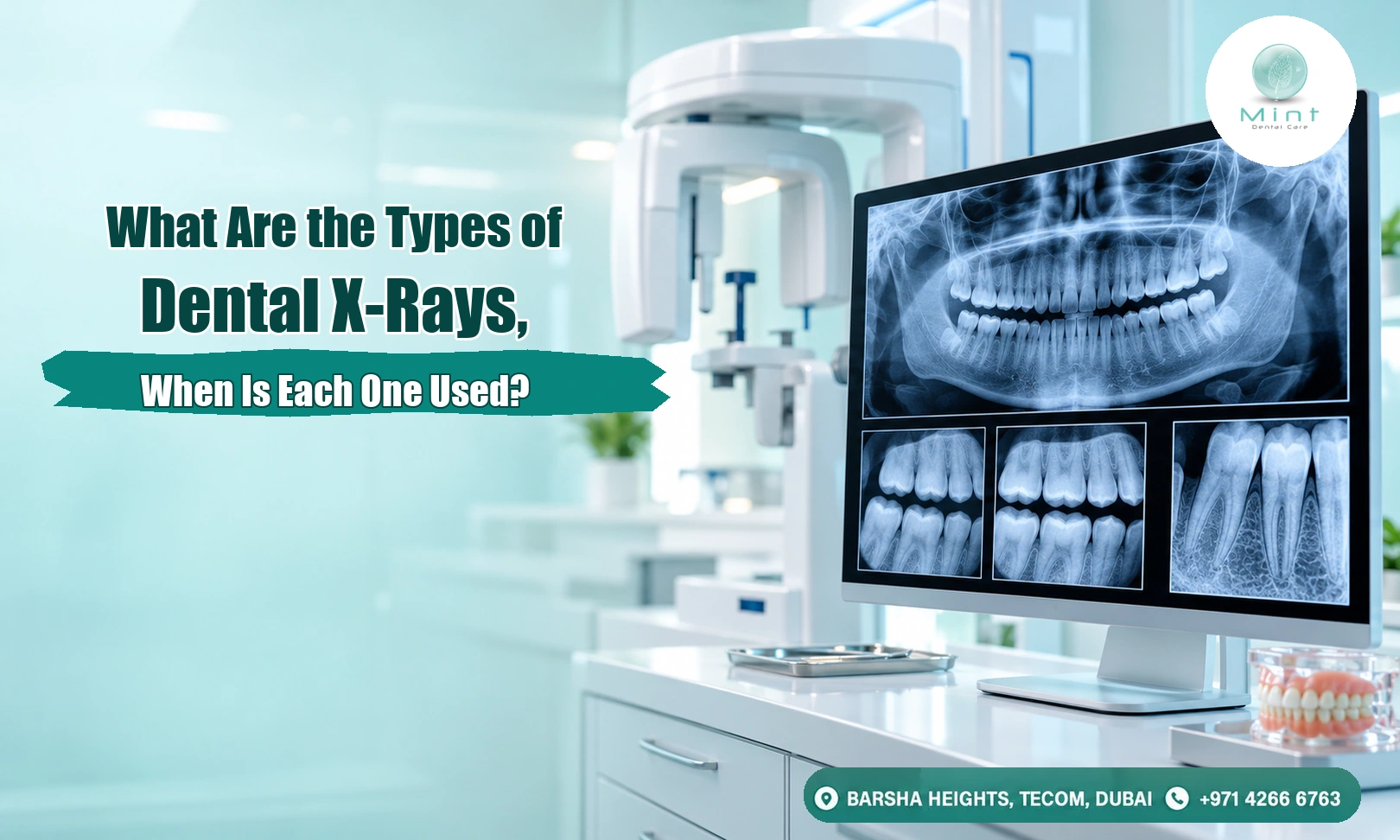
Dental x-rays split into two families: films taken inside the mouth and films taken from outside it. Inside sit the bitewing, the periapical and the occlusal view. Outside sit the panoramic, the CBCT and the cephalometric. A bitewing or a periapical costs AED 150 here and gives roughly 5 microsieverts, about one ordinary day of background radiation. Which film you get depends on the tooth and the question being asked.
The two things a dentist cannot see with a mirror are decay between touching teeth and trouble at a root tip. One small film answers each. The wider views exist for whole jaws and implant sites.
Intraoral vs extraoral dental x-rays
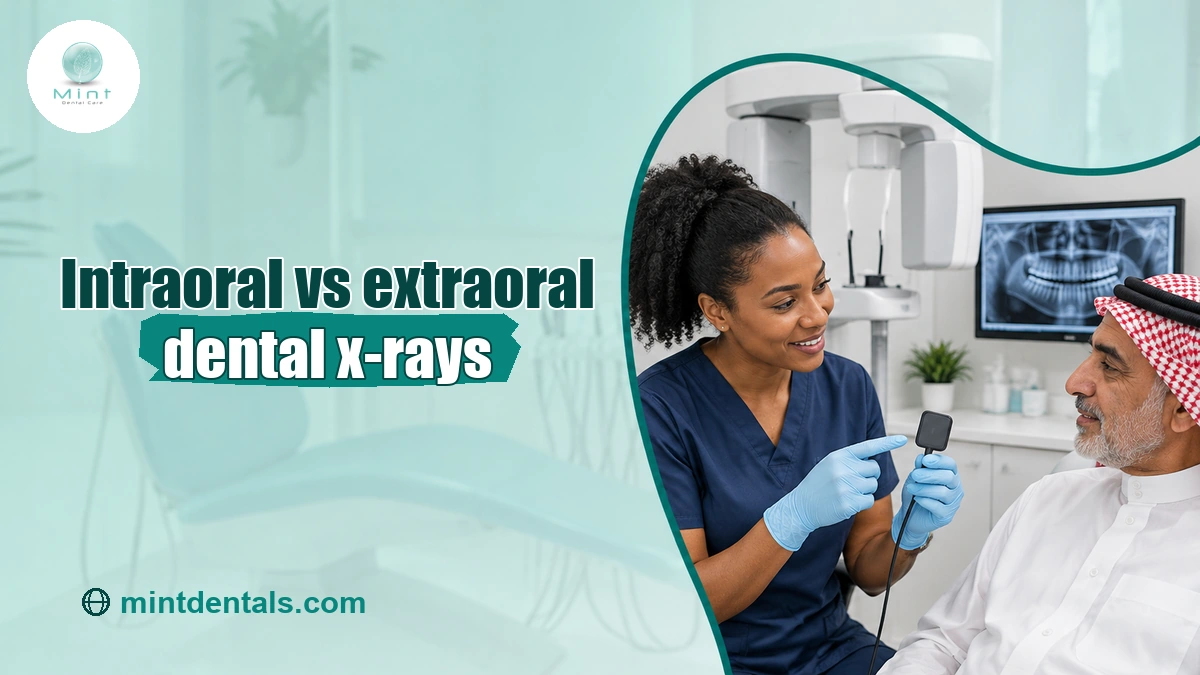
An intraoral film is captured by a sensor inside the mouth, the tube firing through the cheek onto it. An extraoral film keeps everything outside: sensor and tube rotate around your head. Intraoral dental x-rays expose in under a second.
Sensor, holder and bite tab
A digital sensor is a rigid rectangle about the size of a postage stamp. It clips into a holder whose arm and ring square the tube up, and for bitewings that holder carries a bite tab you close your teeth onto.
Films compared at a glance
| Film | Sensor position | What it covers |
|---|---|---|
| Bitewing | Inside, beside the back teeth | Upper and lower back tooth crowns |
| Periapical | Inside, behind the tooth | One or two teeth, crown to root tip |
| Occlusal | Inside, between the biting surfaces | A wide segment of one arch |
| Cephalometric | Outside, beside the head | Side profile of jaws and skull |
Bitewing x-ray for hidden decay
A dental bitewing x-ray is the most often taken of all dental x-rays. It shows the crowns of the upper and lower back teeth on one image, with the bone between them in the middle, and it is the only view that catches decay starting where two teeth press together.
How many bitewings are taken
A standard decay check is four films: premolars and molars on each side, covering every contact point behind the canines. A child with fewer back teeth may need two. Where gum levels are the worry, the films are turned upright instead.
What decay looks like on film
Enamel and bone block x-rays and come out pale. Decay has lost mineral, blocks less and comes out darker. On a bitewing it reads as a dark notch under the contact point. A shadow reaching the dentine usually needs a filling.
Periapical x-ray explained
A periapical film shows one tooth, or two side by side, along its full length: crown, neck, root and the few millimetres of bone wrapping the root tip. Anything happening where the nerve leaves the tooth appears here and nowhere else.
Periapical x-ray for root canal
A root canal needs two or three of these films. One before treatment measures root length and counts the canals. One during confirms the instruments reached the end of each canal. One afterwards records how the filling seals the root.
Occlusal x-ray for children
An occlusal film is wider than the others and is bitten flat between the upper and lower teeth rather than standing on edge. One exposure covers a broad span of one arch, which makes it the fallback among intraoral dental x-rays.
When a sensor will not fit
Small mouths, a strong gag reflex and swelling after a knock make a rigid upright sensor difficult. Because the occlusal film is simply bitten on, most children manage it first time.
Cephalometric x-ray in orthodontics
A cephalometric film is a side view of the whole head, taken with lips at rest and teeth together. It measures how the upper jaw, the lower jaw and the skull base relate, which separates crowding from a jaw position problem.
Cephalometric x-ray price
A cephalometric film is not a line on our published price list, so it is quoted at consultation, as the occlusal film is. The imaging a case needs is discussed as part of the orthodontic plan.
Radiation dose of dental x-rays
Radiation is measured in sieverts, and dental doses are small enough to be quoted in microsieverts, millionths of a sievert. Set against the radiation you absorb anyway from the ground, the air and your food, the figures read easily.
Microsieverts per dental film
A single digital bitewing or periapical film gives roughly 5 microsieverts. A set of four comes to about 20. A cephalometric film sits in the same bracket. CBCT is far higher and rises with the volume scanned.
A day of background radiation
Natural background radiation averages about 2,400 microsieverts a year, roughly 6.5 a day, so one intraoral film sits just under a normal day of living. The yearly limit recommended for the public is 1,000 microsieverts.
| Film | Approximate dose | Everyday equivalent |
|---|---|---|
| Bitewing or periapical | About 5 microsieverts | About one day of background radiation |
| Four bitewings | About 20 microsieverts | About three days |
| Cephalometric | About 5 microsieverts | About one day |
| Panoramic | About 15 to 25 microsieverts | About three days |
| Dental CBCT | About 50 to 200 microsieverts | About one to four weeks |
Shielding for dental x-rays
Shielding is the visible half of protection. The quieter half does more: a sub second exposure, a beam squared off to match the sensor, and digital sensors needing a fraction of what film did. Settings are reduced further for children.
What the collar protects
A lead apron is laid over the chest and lap, and a collar wraps the front of the neck, because the thyroid gland is the radiation sensitive organ nearest the beam. The collar is left off for a panoramic.
Dental x-rays during pregnancy
Dental x-rays are not withheld in pregnancy when there is a clear reason, such as a painful tooth or an abscess, and the apron and collar are used as usual. Routine recall films wait until after delivery, as explained in our guide to dental treatment during pregnancy.
How often dental x-rays are repeated
No single interval fits everybody. Dental x-rays are repeated on risk, so your own history of decay and gum disease sets the gap. An adult with sound teeth may go two to three years between bitewing sets; active decay can mean six to twelve months.
Getting copies of your x-rays
Your images belong to your record, and you can ask for a copy to take to another clinic or a second opinion, usually as digital files the same day.
Dental x-rays cost in Dubai
Our dental x-rays are charged from a published list rather than quoted on the phone, so a visit can be costed in advance. Every fee sits on the dental service prices page, and anything absent from it is quoted at consultation.
| Item | Published price |
|---|---|
| Periapical or bitewing x-ray | AED 150 |
| Panoramic x-ray (OPG) | AED 250 |
| CBCT scan | AED 800 to 1,200 |
| Consultation, general dentist | AED 200 |
| Consultation, specialist | AED 300 |
| Occlusal or cephalometric film | Quoted at consultation |
Periapical x-ray cost
A periapical and a bitewing both cost AED 150, because the sensor and the exposure are the same, and the panoramic is AED 250. A four film check is four of those films, so adding our published figures gives AED 600.
CBCT cost in Dubai
A CBCT scan is AED 800 to 1,200, the range reflecting how much jaw is scanned, and it is requested when a flat film cannot answer the question. Imaging is billed on top of the consultation, broken down in our guide to the routine dental exam cost.
Panoramic and CBCT guides
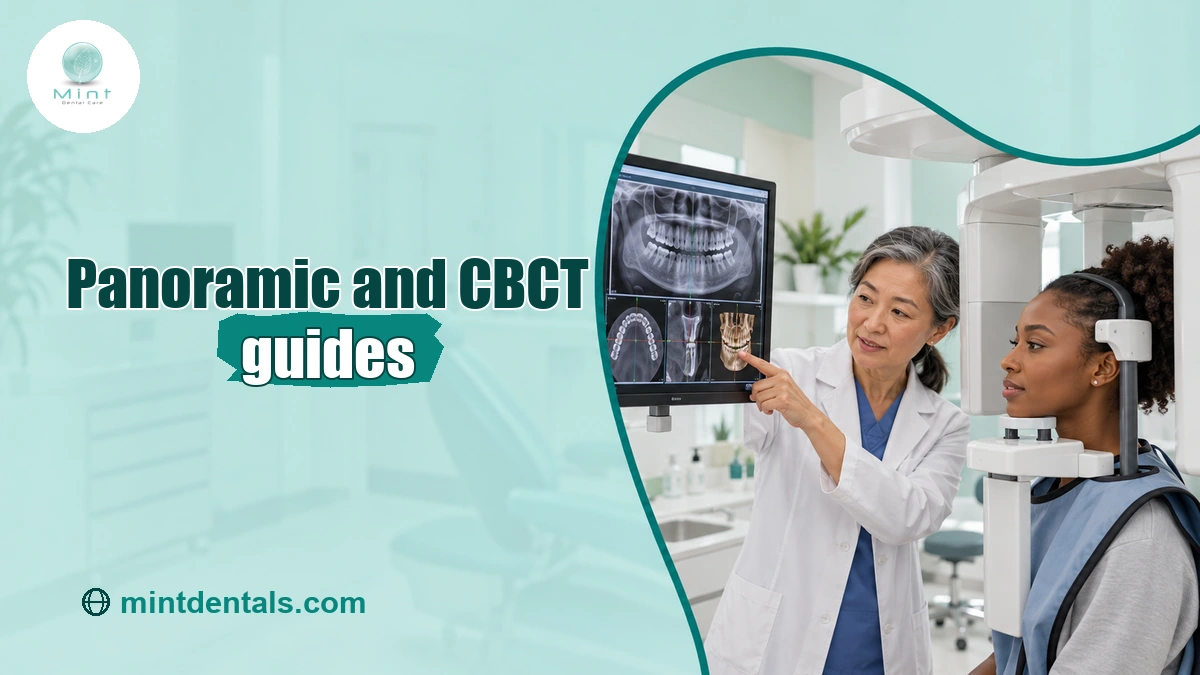
Two of these films carry enough detail of their own to have been written up separately, so this section points you to them rather than repeating what they say.
Where to read about each
The two extraoral workhorses have pages of their own. The panoramic film, which sweeps both jaws in one curve, is covered in our guide to the opg panoramic x-ray. To work out which of the two a case needs, read cbct or panoramic x-ray.
Films follow an examination rather than being booked alone, and what it covers is on our routine dental check-up page. Read together, dental x-rays stop being a mysterious line on a bill: the bitewing watches the contact points, the periapical the root tips, the cephalometric the jaws.
Frequently asked questions
Most questions about dental x-rays come down to two worries: how much radiation is involved, and whether a particular film was really needed. Both are answered directly here.
What is a bitewing x-ray for?
A bitewing shows the crowns of the upper and lower back teeth on one film, so it catches decay starting between touching teeth where a mirror cannot reach. It also shows the height of bone between the roots, which is how gum disease is tracked.
What is the difference between a bitewing and a periapical film?
A bitewing shows the biting halves of several back teeth together and stops above the roots. A periapical shows one or two teeth along their whole length, root tip and bone included. Decay between teeth goes on a bitewing; root problems on a periapical.
How much radiation is in one intraoral dental film?
About 5 microsieverts for a single digital bitewing or periapical, and around 20 for a set of four. Natural background radiation averages roughly 6.5 microsieverts a day, so one film is close to an ordinary day of living. The yearly public limit is 1,000 microsieverts.
Why am I given a lead apron and a thyroid collar?
The apron covers the chest and lap, and the collar covers the thyroid gland, the radiation sensitive organ nearest the beam. The collar is used for films taken inside the mouth and left off for a panoramic, where it would obscure the image.
What is a cephalometric x-ray used for?
It is a side view of the head used in orthodontics to measure how the upper jaw, the lower jaw and the skull base relate, and how much growth a child has left. It separates crowding from a jaw position problem.
How much do dental x-rays cost at Mint Dental Care?
A periapical or bitewing film is AED 150 and a panoramic is AED 250. A CBCT scan is AED 800 to 1,200 depending on how much jaw is scanned. Dental x-rays are billed on top of the consultation, AED 200 general or AED 300 specialist.
Can I ask for copies of my dental x-rays?
Yes. The images form part of your clinical record, and you can request a copy for a second opinion or another clinic, normally as digital files on the same day. Bringing recent images often spares a repeat exposure.