 Barsha Heights, Tecom, Dubai
  +971 (4) 266 6763
Impacted Wisdom Tooth: Signs You Need It Removed
19/07/2026 · tooth extraction
 19/07/2026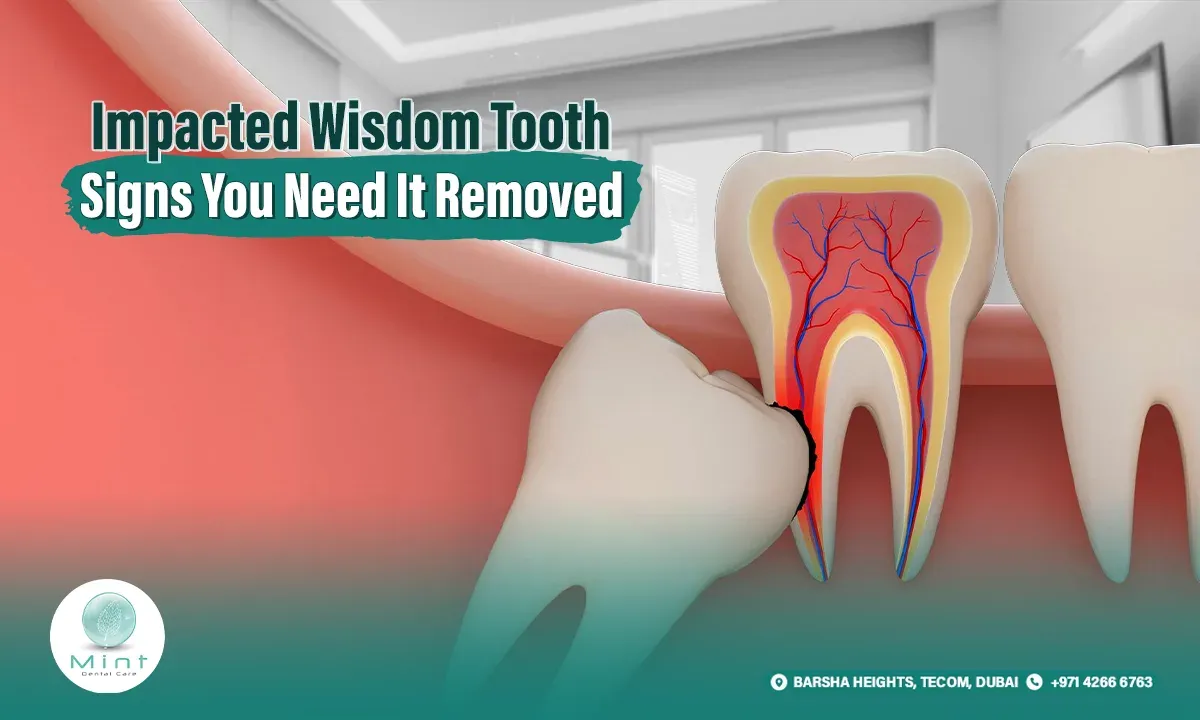
An impacted wisdom tooth is a third molar that cannot fully break through the gum because bone, gum tissue, or a neighbouring tooth is blocking its path. The clearest signs you may need it removed are recurring pain at the back of the jaw, swollen or infected gums around the tooth, and a partially erupted tooth that traps food. Not every case needs surgery, but these symptoms usually tip the balance toward extraction.
Wisdom teeth are the last molars to arrive, usually between ages 17 and 25, and there is often no room left for them. When one is stuck, the question is whether to remove it now or keep it under review. This guide covers the warning signs, when removal is needed versus when monitoring is safer, and what recovery involves.
In pain or worried about a stuck wisdom tooth? Book a quick assessment for wisdom tooth extraction in Dubai at Mint Dental Care. We take an X-ray, tell you honestly whether it needs to come out, and give you a clear plan. Call +971 4 266 6763, WhatsApp us, or book online.
What is an impacted wisdom tooth?
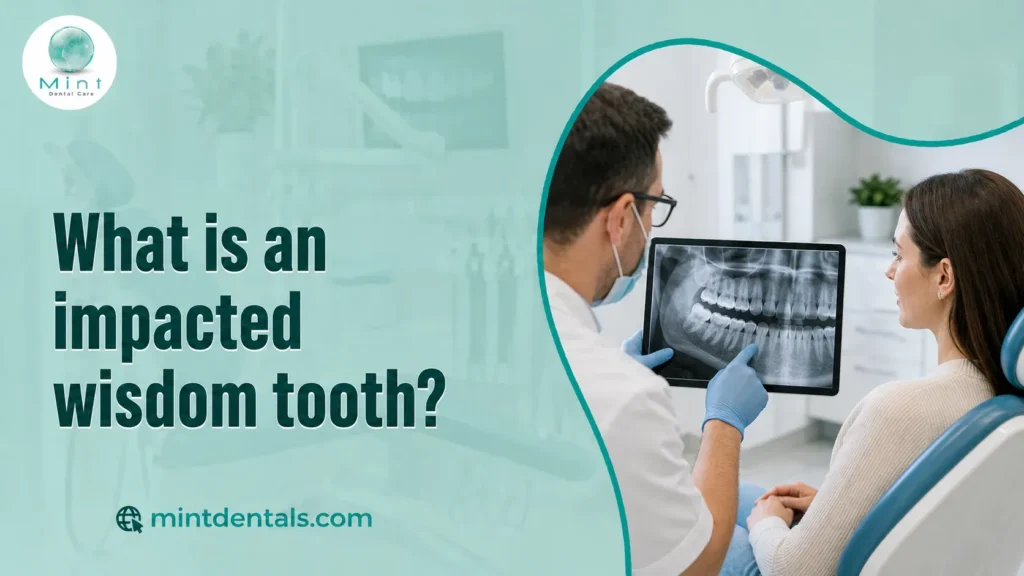
An impacted wisdom tooth is one that fails to erupt into its normal position. Instead of coming through straight, it stays trapped under the gum or bone, or pushes against the molar in front. Dentists describe the impaction by its angle, which helps decide how difficult removal will be.
| Type of impaction | What it means | Typical outlook |
|---|---|---|
| Vertical | Upright but cannot fully emerge from the bone | May erupt or need removal |
| Mesial (mesio-angular) | Tilted forward toward the second molar | Most common; often removed |
| Distal (disto-angular) | Tilted backward, away from the second molar | Usually surgical removal |
| Horizontal | Lying sideways within the jawbone | Almost always surgical |
A tooth can be fully impacted, or partially erupted, where part of the crown breaks through and part stays under the gum. A partially erupted wisdom tooth is often the most troublesome, as the gap around it collects bacteria that brushing cannot reach.
Signs and symptoms of an impacted wisdom tooth
The most reliable impacted wisdom tooth symptoms show up at the very back of the mouth. You may notice one of these signs, or several together:
- Wisdom tooth pain. A dull ache or throbbing at the back of the jaw, sometimes flaring when you chew or open wide.
- Swollen, red or tender gums around the tooth, which may bleed when brushed.
- Jaw stiffness or difficulty opening your mouth on the affected side.
- Bad breath or an unpleasant taste, from food and bacteria trapped around a partially erupted wisdom tooth.
- A flap of sore gum over a half-emerged tooth that can swell into a wisdom tooth infection known as pericoronitis, sometimes with pus or a swollen cheek.
- Pressure or crowding as the tooth pushes neighbouring molars, sometimes with headaches or earache on that side.
Some people have an impacted wisdom tooth with no symptoms at all, found only on a routine X-ray. That does not automatically mean it must be removed, which brings us to the key decision.
When removal is needed vs when to monitor
A common question is, do I need my wisdom teeth out? Not always. Modern dental guidance no longer recommends removing every wisdom tooth by default; it depends on whether the tooth is causing problems, or is likely to. Here is how the two paths compare.
| Monitoring is reasonable when | Removal is usually advised when |
|---|---|
| The tooth is healthy and pain-free | There is recurring pain or wisdom tooth infection (pericoronitis) |
| It has erupted into a good position | It is damaging or decaying the second molar next to it |
| You can clean around it properly | It is trapped at an angle with no chance of erupting normally |
| X-rays show no cysts or decay | A cyst or gum disease has formed around it |
If the tooth is asymptomatic, well-positioned and cleanable, keeping it under review with periodic check-ups is a valid, conservative choice. When to remove wisdom teeth becomes clear once the tooth flares up repeatedly, threatens its neighbour, or cannot be kept clean.
Risks of leaving an impacted wisdom tooth untreated
Monitoring is not the same as ignoring the tooth. A problematic impacted wisdom tooth left untreated can lead to several complications over time:
- Repeated infections (pericoronitis) as the gum flap over a partially erupted tooth traps bacteria, causing recurring swelling that can spread.
- Decay in two teeth at once, since the wisdom tooth and the molar in front are both hard to clean, so cavities form where they meet.
- Gum disease in the hard-to-reach pocket behind the last molar.
- Cysts that can develop around a buried tooth and slowly damage the jawbone.
- Crowding and shifting as ongoing pressure nudges neighbouring teeth out of line.
An untreated infection can also flare suddenly into a swollen, painful emergency. If your face swells, you develop a fever, or you cannot open your mouth, that needs same-day care from an emergency dentist in Dubai. Our guide to emergency wisdom tooth removal in Dubai explains when a flare-up is urgent.
What the extraction involves

Removing an impacted wisdom tooth is a routine procedure. The approach depends on how deeply the tooth is buried and its angle:
- Assessment and X-ray. A panoramic X-ray shows the tooth’s position and its relationship to the nerve, so the dentist can plan safely.
- Anaesthesia. Most extractions use local anaesthetic, with sedation available for anxious patients or complex cases.
- Access and removal. For an impacted tooth, the dentist makes a small gum incision and may remove a little bone or divide the tooth into sections so it comes out gently. Dissolvable stitches often close the site.
Most appointments take about 30 to 60 minutes. Because the steps are more involved than a straightforward tooth, an impacted case falls under surgical tooth extraction. At Mint Dental Care, a surgical or impacted wisdom tooth extraction costs AED 1,000 to 3,000 per tooth, depending on the depth and angle of impaction.
Recovery basics
Recovery is usually straightforward if you follow the aftercare. The first two to three days bring the most swelling, which then settles, with soft-tissue healing over roughly one to two weeks. To help it along:
- Bite gently on the gauze to control bleeding, rest for the first day, and use cold compresses on the cheek for swelling.
- Eat soft, cool foods and chew on the other side.
- Avoid straws, smoking and vigorous rinsing for a few days, as suction can dislodge the clot and cause a painful dry socket.
- After the first day, use gentle warm salt-water rinses, and take any prescribed pain relief or antibiotics as directed.
Contact your dentist if pain worsens after day three, bleeding does not settle, or you develop a fever, as these can signal dry socket or infection.
An impacted wisdom tooth is common and not always a problem, so the aim is the right call for your case, not automatic surgery. If the tooth is healthy and quiet, monitoring is reasonable; if it keeps flaring up, threatens the tooth beside it, or cannot be kept clean, timely removal spares you bigger problems later. A clear X-ray and an honest assessment are the fastest way to know which path is right for you.
Not sure if yours needs to come out? Let us take a look. Mint Dental Care is a MOHAP-licensed clinic with a specialist team and a 4.8-star patient rating. Book an assessment for wisdom tooth extraction in Dubai, WhatsApp us, or call +971 4 266 6763. Mint Dental Care, Barsha Heights (TECOM), Dubai.
Frequently asked questions
What are the first signs of an impacted wisdom tooth?
Usually a dull ache or wisdom tooth pain at the back of the jaw, tender or swollen gums, and bad breath or a bad taste from trapped food. Recurring soreness or a swollen gum flap over a half-emerged tooth are strong hints to get it checked.
Does an impacted wisdom tooth always need to be removed?
No. If it is healthy, well-positioned, pain-free and easy to clean, it can be monitored with periodic check-ups and X-rays. Removal is advised when it causes recurring infection, damages the neighbouring molar, or is stuck at an angle with no room to erupt.
What happens if I leave a problem wisdom tooth untreated?
It can cause repeated infections (pericoronitis), decay in both the wisdom tooth and the molar in front, gum disease, cysts, and crowding. An untreated infection can also flare into a painful, swollen emergency, so ongoing symptoms should not be ignored.
Is removing an impacted wisdom tooth painful?
The extraction itself is not painful, because the area is fully numbed with local anaesthetic. You may feel pressure during the procedure, then some soreness and swelling afterward, which settles within a few days with simple pain relief.
How long does recovery take?
Most people feel much better within three to four days, with soft-tissue healing over about one to two weeks. Soft foods, avoiding straws and smoking, and gentle salt-water rinses all lower the risk of dry socket.
How much does impacted wisdom tooth extraction cost in Dubai?
Surgical removal of an impacted wisdom tooth at Mint Dental Care costs AED 1,000 to 3,000 per tooth, depending on how deeply it is buried and its angle. Sedation, if used, is quoted separately, and a precise quote comes after an X-ray.