 Barsha Heights, Tecom, Dubai
 +971 (4) 266 6763
What Do Invisalign Attachments, Buttons and Elastics Do?
11/10/2026 · Invisalign in Dubai
 11/10/2026
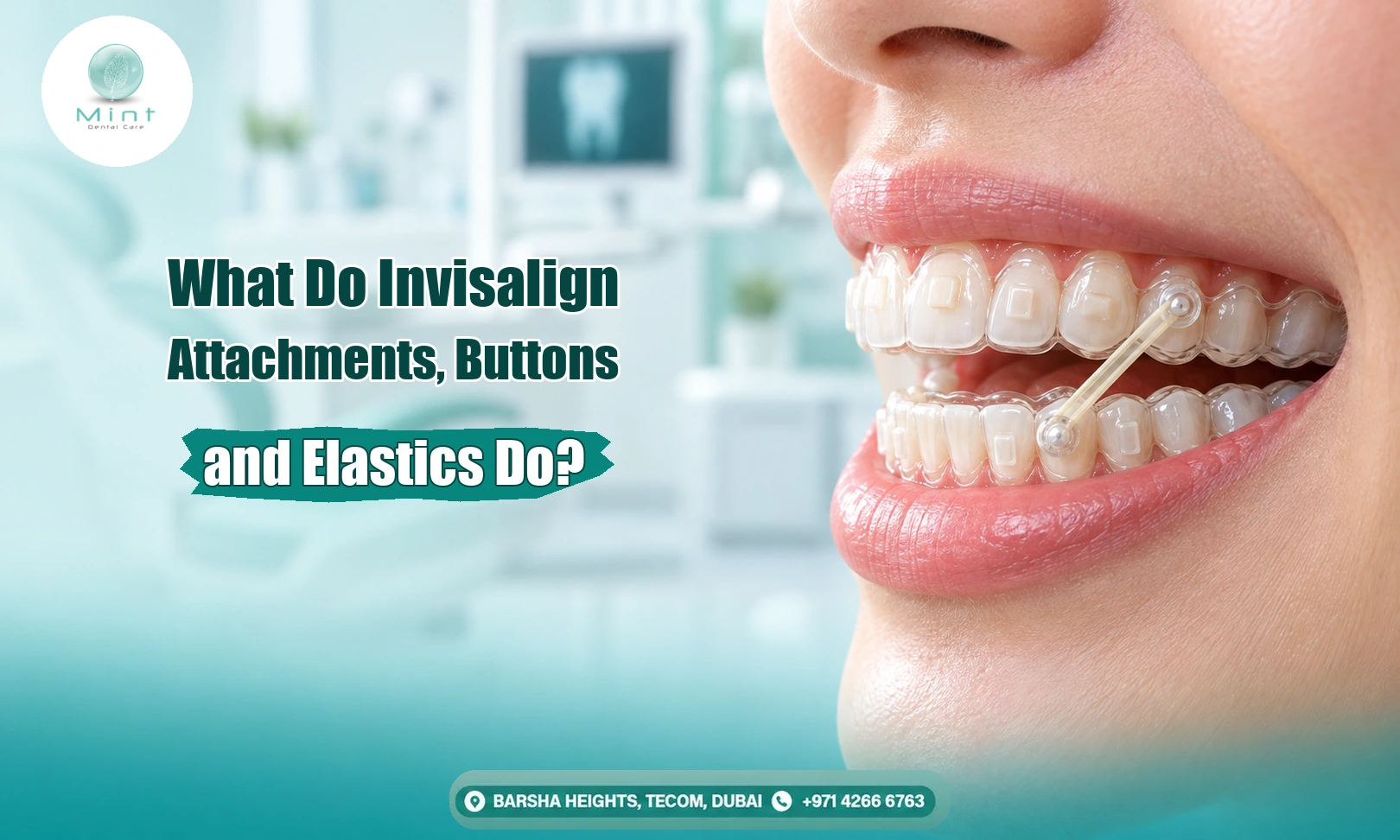
Invisalign attachments are small tooth-coloured composite bumps bonded to chosen teeth so the aligner has a surface to push against. A smooth tray can tip a tooth, but it cannot spin a canine or pull a short tooth down on its own. A course at Mint Dental Care is AED 13,000 to 17,000, and the attachments your plan needs are part of that treatment, confirmed at the consultation.
Three things get mixed up: attachments, buttons and precision cuts. Only one moves a tooth. Elastics are the fourth piece, shifting the whole bite rather than one tooth.
Invisalign attachments vs buttons
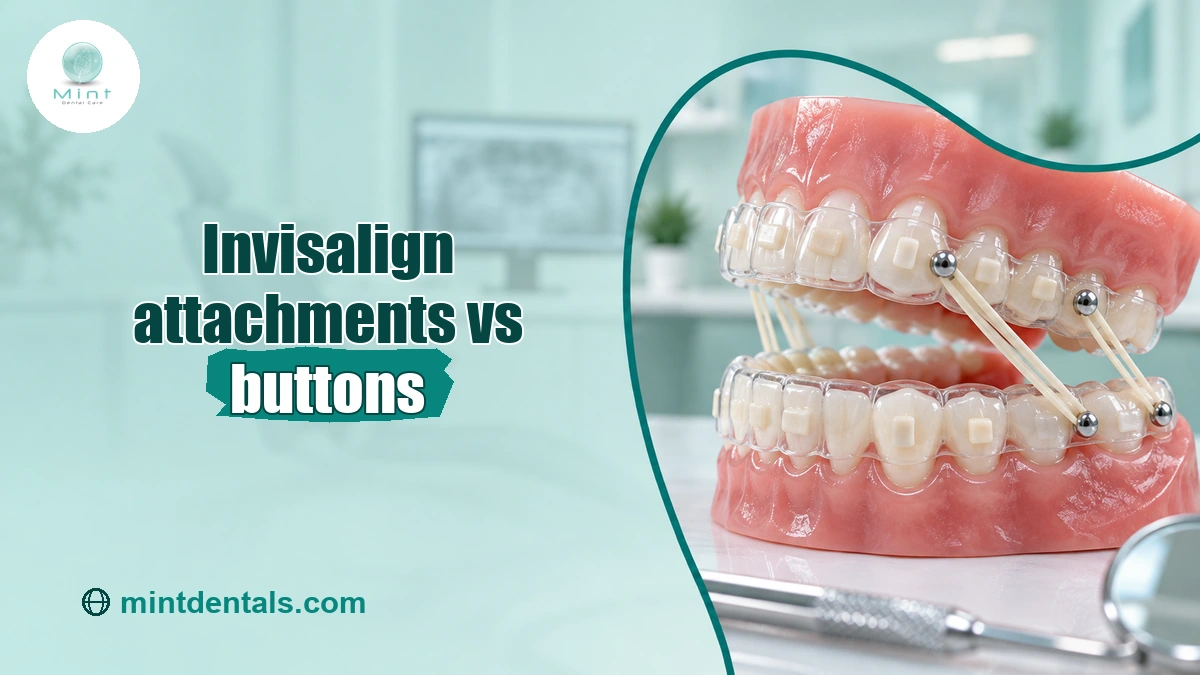
Three small additions do most of the work that a smooth tray cannot, and they are routinely confused with one another. Telling them apart starts with where each one sits and what it is physically attached to.
Attachments, buttons and cutouts compared
Invisalign attachments, buttons and precision cuts are easiest to keep apart by where each sits. Two are bonded to the tooth; the third is a shape cut into the plastic.
| Part | Where it sits | What it does |
|---|---|---|
| Attachment | Bonded to the tooth, under the tray | Rotation, extrusion, anchorage |
| Button | Bonded to the tooth, outside the tray | Nothing alone; holds an elastic |
| Precision cut | Trimmed into the aligner edge | Nothing alone; holds an elastic |
Why a smooth tray slips
Rotating a tooth needs two opposing pushes at different points on the crown, and a round-sided canine gives flat plastic nothing to grip. Extrusion is worse: the tray must lift the tooth from its socket, and it pops off instead.
Invisalign attachments add a ledge with a flat active face. The aligner meets that face and the push becomes a twist or a lift. Attachments on neighbouring teeth do the reverse, holding those teeth still so the force has something to work against.
Attachment shapes and their jobs
| Shape | Planned for |
|---|---|
| Optimised rotation | Spinning canines and premolars |
| Optimised extrusion | Pulling a short tooth down |
| Optimised root control | Moving the root, not just the crown |
| Conventional rectangular | Anchorage, and teeth the software cannot optimise |
How attachments are bonded
Enamel is etched, resin is painted on, and composite is loaded into a clear template holding every bump in its planned place. The template is seated, cured through, then peeled off. Nothing is drilled and no anaesthetic is needed.
Taking attachments off
At the end of treatment Invisalign attachments are polished off with a fine bur and a disc. They sit on the enamel rather than in it, so the tooth is left as it was, and the scan for retainers after invisalign follows.
Precision cuts on aligners
Not every addition is bonded to a tooth. Some are cut into the plastic itself, before the tray is ever printed, and that distinction decides whether anything touches your enamel at all.
Where the notch is trimmed
A precision cut is a notch or slit trimmed into the aligner near the gum line, almost always at a canine or a molar. It is a feature of the plastic, not the tooth, so unlike Invisalign attachments nothing is bonded there.
Planned before the trays print
Precision cuts are decided in the digital plan, before any tray is printed. That is why a mid-treatment change is awkward: the trays in your box have no cut, so the dentist waits or bonds a button.
Buttons bonded to a tooth
When the tray has no cut where an elastic is suddenly needed, the anchor goes on the tooth instead. This usually happens partway through treatment rather than at the start.
When a button is bonded
A button goes on when the aligner has no cut where an elastic is now needed, usually after a refinement. Unlike Invisalign attachments, a button sits proud of the plastic and moves nothing itself.
How a button comes off
Buttons use the same composite as Invisalign attachments, sometimes with a small metal or clear hook set in, and they polish away in a minute. Some are removed and rebonded as the pull changes.
Elastics with Invisalign aligners
Elastics are the part patients most often misunderstand, because they look like the thing doing the straightening. They are not; they move one arch against the other.
Direction of the pull
An elastic does not straighten a tooth; Invisalign attachments do that work. It drags one arch against the other, which is how a bite relationship changes.
| Pattern | Runs from | Effect on the bite |
|---|---|---|
| Class II | Upper canine back to lower molar | Lower teeth forward, upper back |
| Class III | Lower canine forward to upper molar | Lower teeth back, upper forward |
| Cross elastic | Cheek side to tongue side | A tooth on the wrong side of its partner |
| Triangle | Two lower teeth up to one upper | Teeth not meeting vertically |
Class II bite correction
Reducing an overjet asks something of the trays and the elastics at the same time, and neither does it alone. Here is how the two jobs divide.
Reducing an overjet
An overjet is reduced by two things together: the trays move individual teeth, and Class II elastics pull the arches into a new relationship. How much is teeth and how much is jaw is what the assessment for overbites, underbites and crossbites settles.
Elastic wear every day
The hours matter more than the brand of elastic or the size of the attachment. Treatment plans assume a specific daily figure, and the plan quietly fails below it.
Hours a day on elastics
Elastics follow the same clock as the trays: 20 to 22 hours a day, out only for meals and brushing. An arch relationship moves slowly and recoils quickly, so evenings off undo much of the day.
Changing elastics daily
Latex fatigues. A band stretched and released all day delivers less force by evening, which is why elastics are replaced at least once every 24 hours, and sooner if they snap. Carry a few spares in a pocket.
Missed elastics and lost tracking
Skipping elastics does not simply pause progress; it puts the teeth and the tray out of step with each other. What follows is what that feels like and how it is recovered.
Tracking drift after a few days
Skip elastics for three or four days and the teeth the plan was pulling fall behind. You feel it as a gap at the tip of a tooth, or a tray that no longer clicks down over the Invisalign attachments. Later trays then misfit too.
Soreness in the first days
The first two to four days on elastics are usually tender, mostly in the anchor teeth and sometimes the jaw joint, and it settles. Tenderness still sharp after a week is worth a call.
Hooks, slits and cutouts
Run a finger along the aligner edge and you may find three different shapes, each holding an elastic a slightly different way. The one you have was chosen deliberately.
Hook, slit or plain cutout
Along the aligner edge you may see a raised hook the elastic loops over, a narrow slit it threads through, or a plain cutout exposing a bonded button. Any cut is a weak point, so lift the tray off from the back teeth.
When braces work better
Attachments extend what aligners can do, but they do not extend it indefinitely. There is a point where fixed braces or a surgical opinion is the honest answer.
Skeletal cases and surgical opinions
Where the discrepancy sits in the jaws rather than the teeth, elastics and Invisalign attachments can only disguise so much. Large overjets, open bites and marked asymmetries are often better served by fixed braces with skeletal anchorage. The scope of invisalign in Dubai is on the treatment page.
Mid-course refinement
Many cases need a refinement: a new scan part way through, new trays, and often new Invisalign attachments in different positions. It is normal rather than a failure, and the breakdown of invisalign cost in dubai sets out the course.
Attachments and chewies in brief
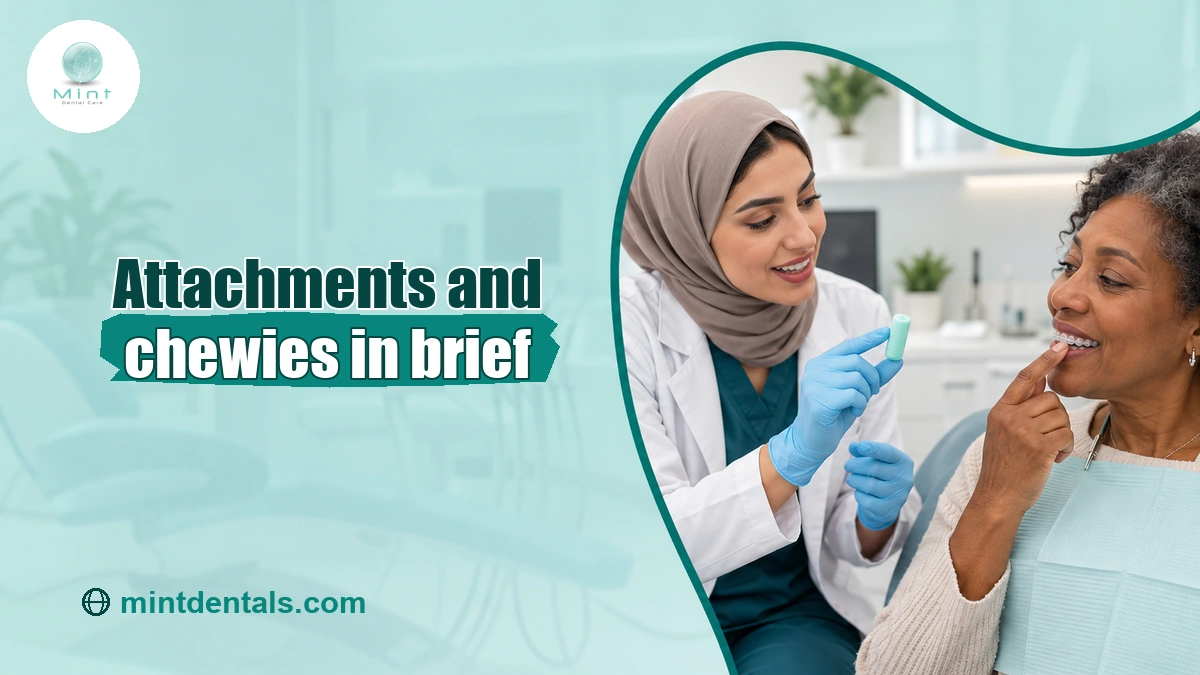
A few practical questions come up every week of treatment: seating the tray properly, keeping the bumps from staining, and what to do when one comes off.
Seating a tray over attachments
Chewies are the small foam cylinders you bite on to seat a tray fully over the attachments, and whether they and the attachments are really necessary is answered in the guide to common mistakes during invisalign treatment.
Staining and cleaning
Composite is slightly more porous than enamel, so Invisalign attachments on front teeth pick up colour from coffee, tea, red sauces and smoking, and a stained bump shows as a dark outline through clear plastic. Brush every bump directly.
When an attachment comes off
One popping off is common, usually on a lower front tooth or a hard-chewing molar. The tray feels loose there and that tooth stops moving. Call the clinic, because rebonding takes minutes and weeks of wear without it does not.
Most of what decides an aligner result is not the plastic. It is whether the Invisalign attachments stay bonded where the plan put them, whether the elastics are on for 20 hours a day, and whether anything loose is fixed in days. How many Invisalign attachments your case needs, and what retainers cost, is settled at the consultation.
Frequently asked questions
The questions below are the ones asked at review appointments, mostly about what each addition is for and what happens when an elastic or an attachment is missed.
What is a precision cut on an Invisalign aligner?
It is a notch or slit trimmed into the tray edge near the gum, usually at a canine or molar, so an elastic hooks onto the plastic. Nothing is bonded to the tooth. The cut is designed before printing, so it cannot be added later.
What is the difference between Invisalign attachments and buttons?
Invisalign attachments are composite bumps under the tray that move a tooth by giving the plastic something to push on. A button is bonded on top of the tooth, outside the tray, and moves nothing by itself; its only job is to hold an elastic. Both polish off.
Do Invisalign elastics hurt?
The first two to four days are usually tender, mainly in the teeth the elastic hooks onto and sometimes in the jaw joint, and it eases as those teeth settle. Paracetamol and softer food cover most of it. Sharp pain after a week should be checked.
How many hours a day do Invisalign elastics have to be worn?
Twenty to 22 hours a day, the same as the trays, out only for eating and cleaning your teeth. Bite changes are slow to gain and quick to lose, so evenings off cost more than they seem. They are replaced at least once daily.
Can Invisalign correct an overbite without braces?
Many bites improve with trays plus elastics, because the trays reposition individual teeth while the elastics change how the arches meet. How far it goes depends on whether the problem is tooth position or jaw position. A skeletal case may still need fixed braces or surgery.
What happens if I stop wearing my elastics?
The planned bite change stalls while the trays keep advancing, so within days the teeth fall behind the plastic and the tray stops seating over the Invisalign attachments. The usual outcome is a refinement: new scan, new trays, new attachment positions and a later finish date.
Can a button be bonded if my aligner has no cut?
Yes, and that is why buttons exist. If the plan included no precision cut on the tooth now needed for a pull, the dentist bonds a button to it and may trim a small window in the tray so the elastic reaches it. One short appointment.