 Barsha Heights, Tecom, Dubai
 +971 (4) 266 6763
Protruded Teeth (Overjet): What Causes Them, and How Are They Corrected?
13/10/2026 · Braces in Dubai
 13/10/2026
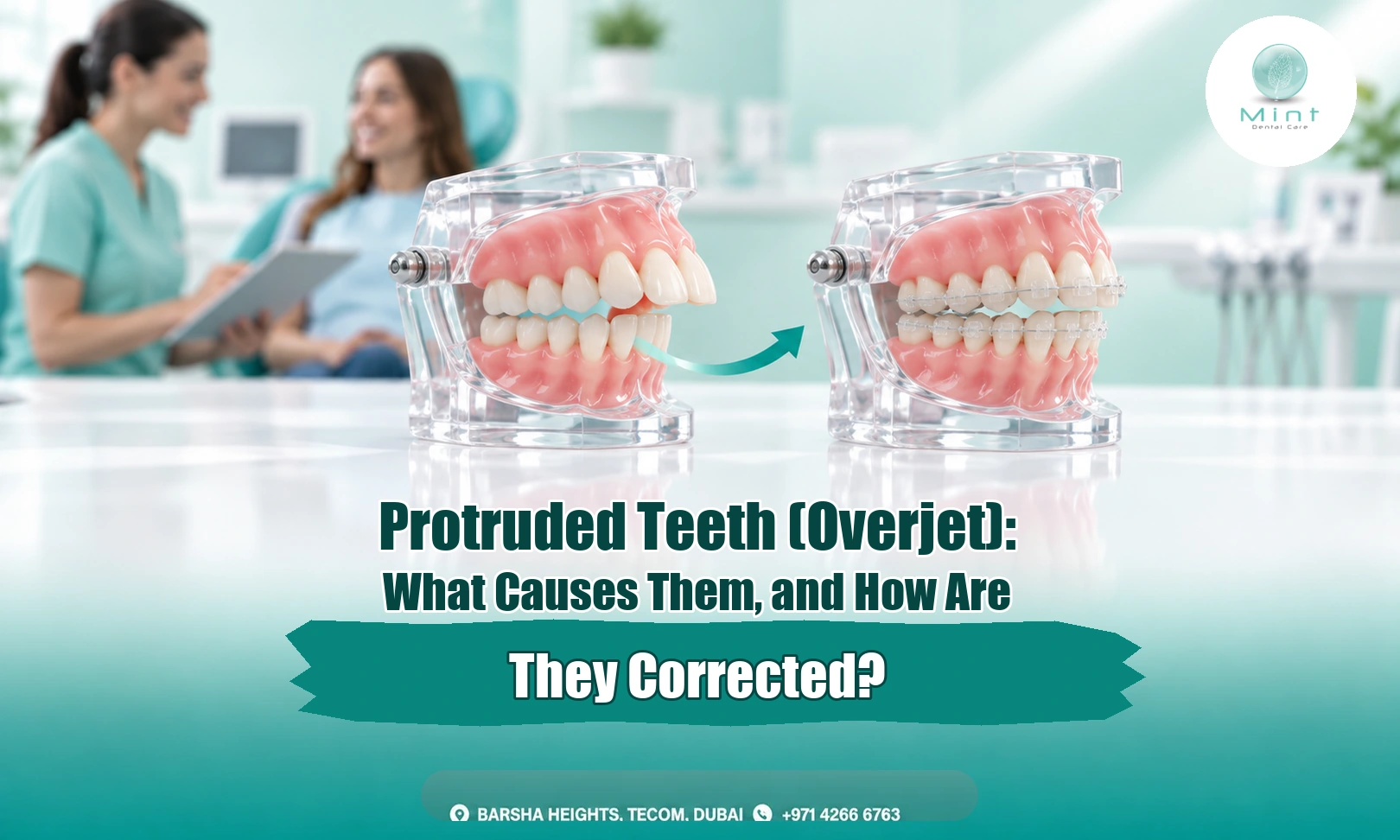
Protruded teeth, which orthodontists record as an increased overjet, means the upper front teeth sit more than 2 to 3 mm ahead of the lower ones. The cause is dental, with the teeth tipped forward, or skeletal, with the jaws positioned differently. Braces cost AED 11,000 to 13,000; a skeletal case in an adult may need surgery.
That distinction decides everything after it. Teeth tipped forward inside jaws that meet reasonably well can be tipped back at any age. A lower jaw set behind the upper one is different: a child can be steered, an adult needs an operation.
What are protruded teeth?
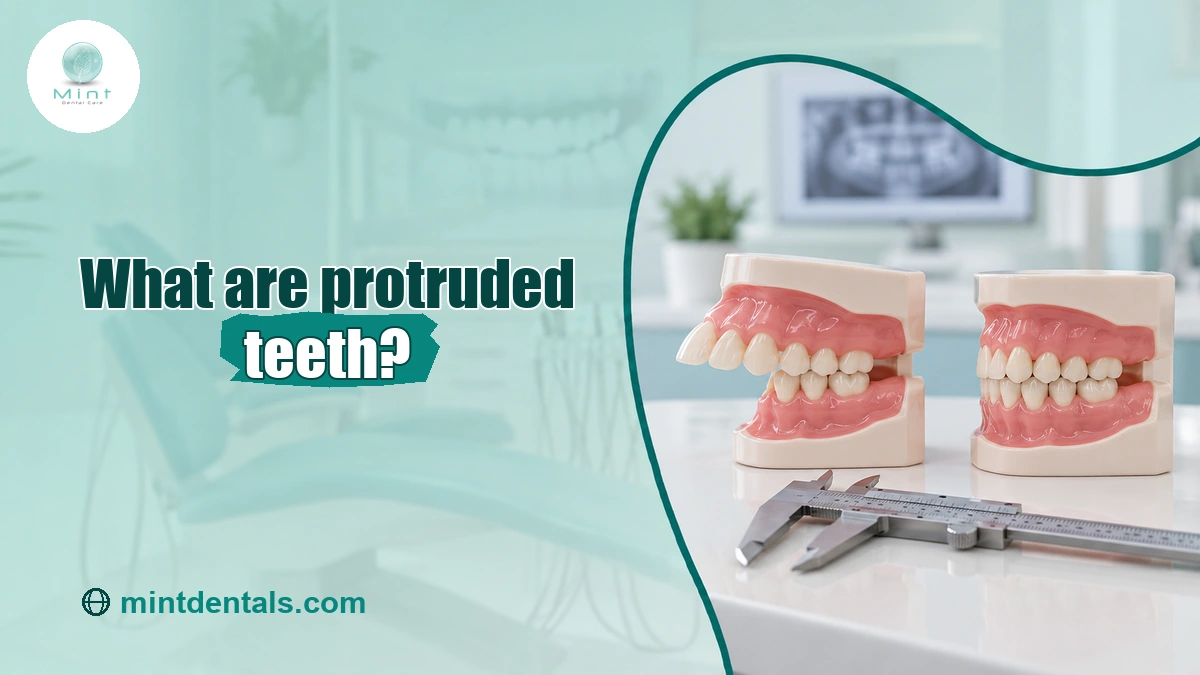
Protruded teeth are upper incisors sitting further forward than the lower ones by more than 2 to 3 mm. Orthodontists call that horizontal gap the overjet. Beyond roughly 4 mm it counts as increased; beyond 9 mm it is almost always skeletal.
Measuring overjet in millimetres
The reading is taken with the back teeth together, from the front of the lower incisor to the tip of the upper one. Two to three millimetres is normal, 4 to 6 mm moderate, and past 6 mm the lips often will not meet.
Dental protrusion vs skeletal protrusion
Dental protrusion means the crowns are tipped forward on jaws positioned acceptably. Skeletal protrusion means the jaw bases differ, usually because the lower jaw is set back rather than the upper jaw pushed out. The two look alike in a photograph and separate on an X-ray.
| Dental | Skeletal | |
|---|---|---|
| Where it sits | Crowns tipped forward | Jaw bases positioned differently |
| Profile at rest | Lips can often meet | Chin set back, lips apart |
| What corrects it | Braces or clear aligners | Growth guidance, or jaw surgery |
| Age limit | None, teeth move at any age | Guidance ends when growth does |
Overjet vs overbite
Overjet is horizontal, overbite is vertical. Overjet is how far forward the upper incisors sit; overbite is how much of the lower incisor they cover. So protruded teeth can exist with almost no vertical overlap. Underbites, crossbites and deep bites sit in our guide to overbites, underbites and crossbites.
Causes of protruded teeth
The causes of protruded teeth split into inheritance and habit. A small or backward set lower jaw runs in families and is the commonest reason for a large overjet. Habits then worsen a tendency already present.
Thumb sucking past age four
A thumb or dummy held in the mouth for hours a day pushes the upper incisors forward and the lower ones back. Before about age four the teeth mostly recover once it stops. Past six, the change tends to stay.
Mouth breathing and enlarged adenoids
A child who cannot breathe through the nose, from allergy or enlarged adenoids, keeps the lips apart and the tongue low. The upper arch narrows without tongue support and the front teeth drift forward unopposed. The airway is treated first.
Tongue thrust and lip trap
A tongue pressing the incisors on every swallow applies a light force hundreds of times a day, enough to move teeth. A lip trap does the same: the lower lip rests behind the upper incisors and levers them out.
Injury risk to upper incisors
Protruded teeth raise the chance of an accident to the front teeth, and that is the consequence people miss. The typical injury is a chipped or knocked out upper incisor between seven and twelve, and published figures put the risk at roughly double past 4 mm.
Lip competence and speech
Lip competence means the lips meet without effort at rest. Past about 6 mm they often cannot, so the upper incisors stay exposed and dry, the gum inflames and those teeth stain faster. A large overjet can also distort s and z sounds.
Mouthguards for sport
Anyone with protruded teeth who plays contact sport should wear a mouthguard, and a custom made guard protects better than a shop bought tray. Mouthguards are not on our published list, so they are quoted at consultation.
Braces or aligners for protruded teeth
Braces and clear aligners both correct protruded teeth when the problem is dental, tipping the crowns back and sometimes moving them into space created elsewhere. Braces are AED 11,000 to 13,000 and Invisalign AED 13,000 to 17,000; what each involves is on our braces in Dubai page, and our adult braces guide compares them for a late start.
Extraction vs non-extraction plans
Space has to exist before an incisor can move back. It comes from widening the arch, filing fractions of a millimetre off contact points, or removing a tooth. An overjet of 4 to 6 mm often needs no extraction; larger cases need the upper first premolars out.
When jaw surgery is needed
Surgery enters the conversation when the jaw bases sit far apart and growth has finished. Moving teeth can still improve how the bite works, but it cannot move a chin set too far back. Protruded teeth of skeletal origin are where that limit shows.
Limits of camouflage in adults
Camouflage means accepting the jaw positions and lining the teeth up inside them, usually after upper premolar extractions. The bite works and the teeth look straight, but the profile does not change, and the incisors can finish tipped too far back.
What orthognathic surgery involves
Orthognathic surgery moves the lower jaw forward, the upper jaw back, or both. A maxillofacial surgeon performs it in a hospital theatre under general anaesthetic, not in a dental clinic; the clinic handles the orthodontics around it. Our orthognathic surgery guide explains the route, and the operation is quoted at consultation.
Early treatment in children
Age changes what is possible, so a child with protruded teeth is worth seeing at about seven, once the permanent incisors are through. While the lower jaw is still growing an appliance can influence that growth. Our early orthodontic intervention guide covers the visit.
Functional appliances during growth
A functional appliance such as a twin block holds the lower jaw forward so the muscles and joint adapt, worn through the pubertal growth spurt, roughly ages ten to fourteen. The gain is genuine but modest, and nothing holds while a habit continues. Functional appliances are quoted at consultation.
Which route suits which age
| Age | What is realistic |
|---|---|
| Under 10 | Stop the habit, treat the nose, monitor |
| 10 to 14 | Functional appliance can guide jaw growth |
| Adult | Braces, aligners, or surgery if skeletal |
Correction cost and timeline in Dubai
Correcting protruded teeth in Dubai starts with a specialist orthodontist consultation at AED 300, where the overjet is measured and the routes explained. Records include a panoramic X-ray at AED 250 and sometimes a CBCT scan at AED 800 to 1,200. Treatment usually runs 18 to 30 months.
Braces and Invisalign prices
| Item | Price in AED |
|---|---|
| Specialist consultation | 300 |
| Panoramic X-ray | 250 |
| CBCT scan | 800 to 1,200 |
| Braces | 11,000 to 13,000 |
| Invisalign | 13,000 to 17,000 |
| Appliances, retainers, surgery | Quoted at consultation |
Anything not on that published list is quoted after assessment, and our breakdown of braces cost in Dubai sets the figures against a full course.
Retainers and relapse
Protruded teeth relapse more readily than most corrections, because the forces that caused them keep working after the braces come off. A retainer is worn nightly for the long term, often with a bonded wire. Retainers are quoted at consultation.
The question is not whether braces can straighten protruded teeth, because they usually can. It is whether the teeth or the jaws are out of position, and how much growth is left. One specialist visit with the right X-rays answers both, and in a growing child that decides between guiding a jaw and operating later.
Mint Dental Care, Barsha Heights (TECOM), Dubai. A MOHAP-licensed clinic with a 4.9-star patient rating. To have an overjet measured by a specialist orthodontist, call +971 4 266 6763, WhatsApp us or book online.
Frequently asked questions
Overjet brings up questions about age, appearance and what treatment actually involves, and the answers change depending on whether the teeth or the jaws are the cause. Each answer below says which case it applies to.
Can protruded teeth be fixed without surgery?
In most cases, yes. Protruded teeth that are dental, with the crowns tipped forward on acceptably positioned jaws, respond to braces or clear aligners alone, sometimes with upper premolar extractions for space. Surgery is only raised when the jaw bases themselves sit far apart.
At what age should a child with protruding front teeth be seen?
Around age seven, once the permanent upper incisors are through. Nothing usually starts then, but the jaw pattern becomes visible while most growth is still ahead, which keeps open the option of guiding the lower jaw with a functional appliance later.
Does thumb sucking really cause teeth to stick out?
It contributes rather than causes. Sucking for hours a day pushes the upper incisors forward and the lower ones back, and past about age four the change starts to stay. A child who inherited a backward set lower jaw is affected more.
How long does it take to pull front teeth back with braces?
Between 18 and 30 months for most cases. The retraction itself takes six to nine months once space has been created, but the alignment before it and the bite settling after it take longer. Extraction cases sit at the upper end.
Will Invisalign correct protruding front teeth?
For a mild to moderate overjet, yes. Aligners tip and retract the upper incisors, with elastics on small buttons helping hold the lower jaw forward. Invisalign is AED 13,000 to 17,000. Large retractions and clearly skeletal cases suit fixed braces better.
Do protruding teeth move back out after treatment?
They can, more readily than most corrections. The lip and tongue forces that pushed the teeth out keep working once the braces come off, so a retainer is worn nightly for the long term, often together with a thin wire bonded behind the upper incisors.
How much does braces treatment cost in Dubai?
Braces at our clinic are AED 11,000 to 13,000 and Invisalign is AED 13,000 to 17,000. A specialist orthodontist consultation is AED 300 and a panoramic X-ray is AED 250. Functional appliances, retainers and jaw surgery are quoted after assessment.