 Barsha Heights, Tecom, Dubai
 +971 (4) 266 6763
Which Tooth Fix Bridge Design Suits a Missing Tooth?
17/10/2026 · Crowns and Bridges in Dubai
 17/10/2026
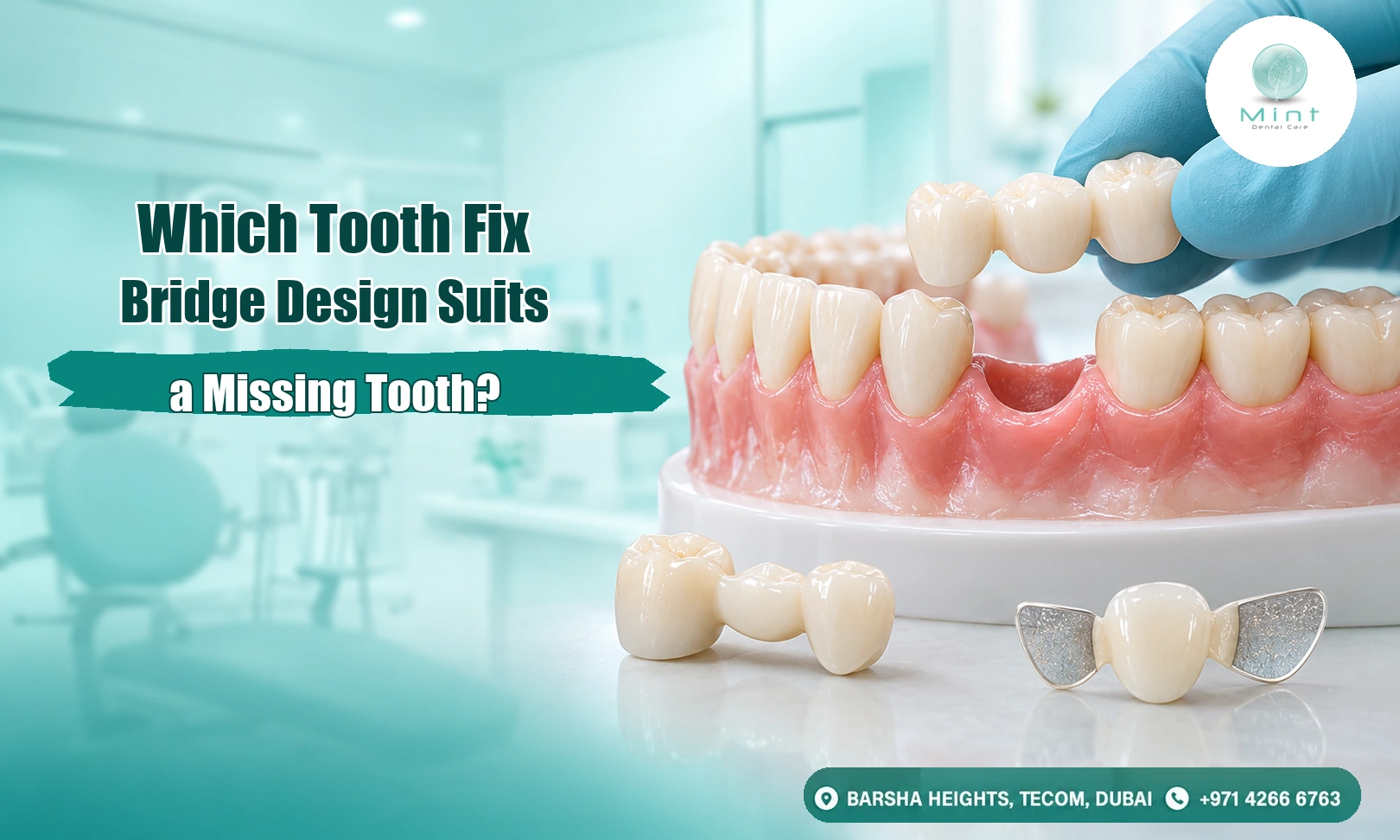
Tooth fix bridge designs come in four shapes: the three-unit fixed bridge, the cantilever, the Maryland resin-bonded bridge, and the implant-supported bridge. They differ most in what they take from you. A fixed bridge prepares two healthy teeth, a cantilever one, a Maryland almost no enamel, and an implant-supported bridge none at all. Units are priced at AED 1,500 to 3,000 per tooth.
That trade is the whole decision. Every tooth fix bridge solves one problem: how to hold a false tooth over a gap so it chews like the tooth that left. What changes is where the load travels, and what gets drilled to receive it.
Tooth fix bridge designs compared
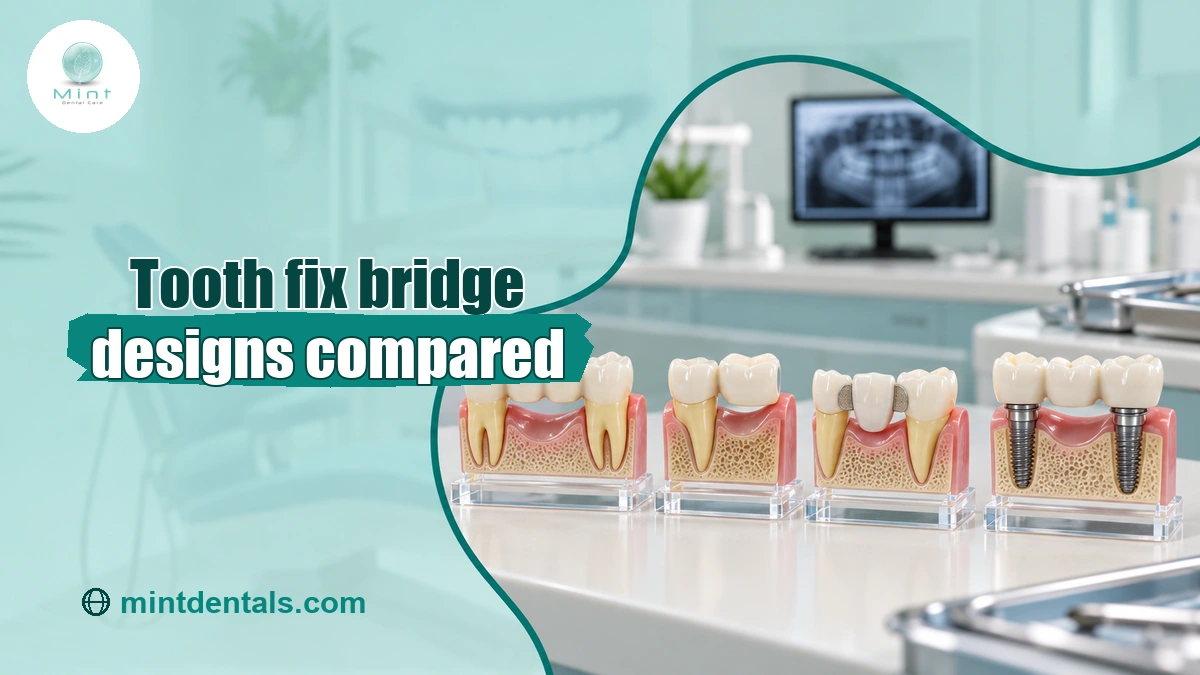
Comparing the four designs needs two pieces of vocabulary first, because every difference between them is described with the same pair of words. Once those are clear, the table below reads in one pass rather than being guessed at from the names.
Four designs, side by side
Two words first. The abutment carries the bridge, either a prepared tooth or an implant. The pontic is the false tooth that spans the gap, touching gum but anchored to nothing beneath it. Read the table across, not down.
| Design | How it is held | Healthy tooth prepared | Suits | Service life | Wrong choice when |
|---|---|---|---|---|---|
| Three-unit fixed | Crowns cemented either side | Two teeth, all round | One gap, solid neighbours | Often 10 to 15 years | Neighbours are untouched |
| Cantilever | One crowned tooth, one side | One tooth, all round | Support on one side | Shorter, load dependent | The gap is a molar |
| Maryland | Wings bonded to inner surfaces | Almost none | A single front gap | Debonding is common | You grind your teeth |
| Implant-supported | Implants in jaw bone | None | Longer spans, good bone | Longest of the four | Bone volume is limited |
Crown vs bridge, in one line
A crown rebuilds a tooth you still have, while a tooth fix bridge replaces one you do not, and the appliance itself is explained on the clinic’s dental crowns and bridges page. This article assumes you are past that and are choosing a design.
Three-unit fixed bridge
This is the tooth fix bridge most people picture when a gap is discussed, and the one a dentist will usually offer first. Its appeal is in how the force is shared, and its cost is in how many teeth have to be committed to sharing it.
How a fixed bridge is held
Three units means three joined pieces: crown, pontic, crown. The outer crowns are cemented onto the teeth either side of the gap, so biting force spreads across both. It is the oldest tooth fix bridge design and still the usual one.
Two prepared teeth per span
Both neighbours are reduced on every surface, roughly one to two millimetres of enamel each. Those teeth are then committed. If one fails in ten years the bridge fails with it, because the units are fused and cannot be separated.
When a fixed bridge is wrong
It is the wrong tooth fix bridge when both neighbours are intact and unfilled. Drilling two sound teeth to replace one missing tooth is a poor exchange, and that is the case where an implant-supported design earns its higher cost.
Cantilever bridge explained
Halving the number of teeth prepared is the selling point of this design. The physics of holding a false tooth from one end only is what decides where it works and where it quietly destroys its own support.
One abutment, and the leverage
A cantilever hangs the pontic off one side only, held by a single crowned tooth. Fewer teeth prepared sounds like a straight win until you look at the mechanics: the pontic works as a lever arm on that abutment at every bite.
When a cantilever is wrong
Avoid this tooth fix bridge in the molar region, where bite force is highest and leverage does the most damage. Over years the single abutment can loosen, tilt or crack, and a cracked abutment is often unsavable rather than repairable.
Maryland bridge teeth
Of the four, this is the tooth fix bridge that asks least of the teeth either side, which is also why it holds on least firmly. Knowing how it is actually attached explains both halves of that bargain before you weigh it up.
Wings bonded behind the neighbours
A Maryland bridge, also called resin-bonded, carries the pontic on two thin wings cemented to the back surfaces of the neighbouring teeth. Nothing is crowned. From the front you see a false tooth and two teeth that look untouched.
Minimal preparation, and debonding
Preparation is a light roughening of enamel, sometimes none, which makes Maryland bridge teeth the most conservative fixed option. The trade is retention: the appliance is held by adhesive over a small area, so it can come away in one piece without warning.
When a Maryland is wrong
Rule it out for molars, for anyone who clenches or grinds, and where the neighbours are heavily filled, since a wing needs sound enamel to bond to. On a lower front gap with a light bite it remains a sensible choice.
Implant-supported bridge
Taking the anchorage out of your own teeth and into the jaw bone changes the arithmetic of a tooth fix bridge completely: what it costs, how long it takes, and what has to be true of your bone before it is even an option.
Implants carrying the span
Here the tooth fix bridge sits on titanium implants placed in the jaw rather than on teeth. Two implants can carry three or four units, so a longer gap is spanned without recruiting any natural tooth. Healing before loading takes three to six months.
Neighbouring teeth left alone
This is the only design that costs you no enamel. The neighbours keep their outer surfaces, stay independently cleanable, and can be treated separately later. The wider comparison sits in our guide to dental implants vs bridges.
When implants are not possible
Bone volume decides it. Where the ridge has shrunk, grafting at AED 2,500 may come first, and some medical conditions or heavy smoking make healing unreliable. A CBCT scan at AED 800 to 1,200 answers the question properly.
Tooth fix bridge: the enamel cost
Everything else on this page can be revised later: a crown remade, an implant replaced, a wing rebonded. Enamel cannot. That makes the amount of tooth structure each design consumes the part of the decision worth measuring most carefully.
Enamel removed per design
Set the four tooth fix bridge designs side by side and the difference is stark. This is the one part of the decision that cannot be undone, whatever happens to the bridge afterwards.
| Design | Teeth touched | Depth of preparation | Reversible? |
|---|---|---|---|
| Three-unit fixed | 2 | Full coverage, every surface | No |
| Cantilever | 1 | Full coverage, every surface | No |
| Maryland | 2 | Inner surface only, minimal | Largely yes |
| Implant-supported | 0 | None on teeth | Not applicable |
Why prepared teeth need root canals
Reducing a tooth on all sides brings the drill close to the nerve, and a proportion of crowned teeth become sensitive or die quietly over the years. Root canal treatment then runs AED 1,500 to 3,500, done through the bridge or by remaking it.
Front teeth vs back teeth
Where the gap sits in the arch narrows the shortlist before anything else does. Bite force at the back is several times what the front teeth handle, and the teeth available as support are built to different dimensions at either end of the jaw.
Front gap vs molar gap
Lower incisors are small, thin and lightly loaded, so crowning two of them to span one gap removes much of what little tooth there is. A Maryland is often the better match, and an implant is tight between narrow roots.
Molars take the heaviest force in the mouth. A Maryland will debond there and a cantilever sits under too much leverage, which leaves two tooth fix bridge options: a three-unit fixed span or an implant-supported one.
Materials by design
Metal-ceramic still suits long posterior spans, zirconia covers most cases, and lithium disilicate is kept for bonded front work such as Maryland wings. Material does not change the price band, and each is compared in our guide to types of dental crowns.
Bridge failure modes
Each tooth fix bridge has a characteristic way of giving up, and knowing yours tells you what to watch for and how urgent it is when it happens. Some failures announce themselves in one piece. Others work away under porcelain where you cannot see them.
Debonding of a Maryland
The classic Maryland failure is clean separation: a wing lets go, the bridge comes off intact, and it can often be cleaned and rebonded the same week. Keep the piece, do not glue it yourself, and stop chewing on that side.
Decay under a crown
A fixed or cantilever tooth fix bridge rarely falls off. It fails underneath, where decay creeps in at the crown margin and stays hidden until it is deep, or where porcelain chips off the biting surface. Either way it is sectioned and remade.
What to do when one loosens
Movement, a bad taste or food packing under the pontic mean the seal has gone, and a loose bridge left in place lets decay run. Our page on a broken dental bridge covers the first day and what not to do.
Bridge span length limits
How many teeth one appliance can replace is not a matter of opinion, and it is not settled by making the metal thicker. There is a calculation behind it that puts a hard limit on any tooth fix bridge held by natural teeth.
The root support rule
Dentists weigh the root surface of the abutments against the root surface of the teeth being replaced, and want support to at least equal load. Two small incisors cannot carry three missing molars, whatever the bridge is made of.
Two missing teeth in a row
A four-unit span flexes more than a three-unit one, and flexing breaks cement seals. Past two pontics in a row most dentists stop offering a tooth-supported design, because the arithmetic of support stops working.
Choosing a bridge design
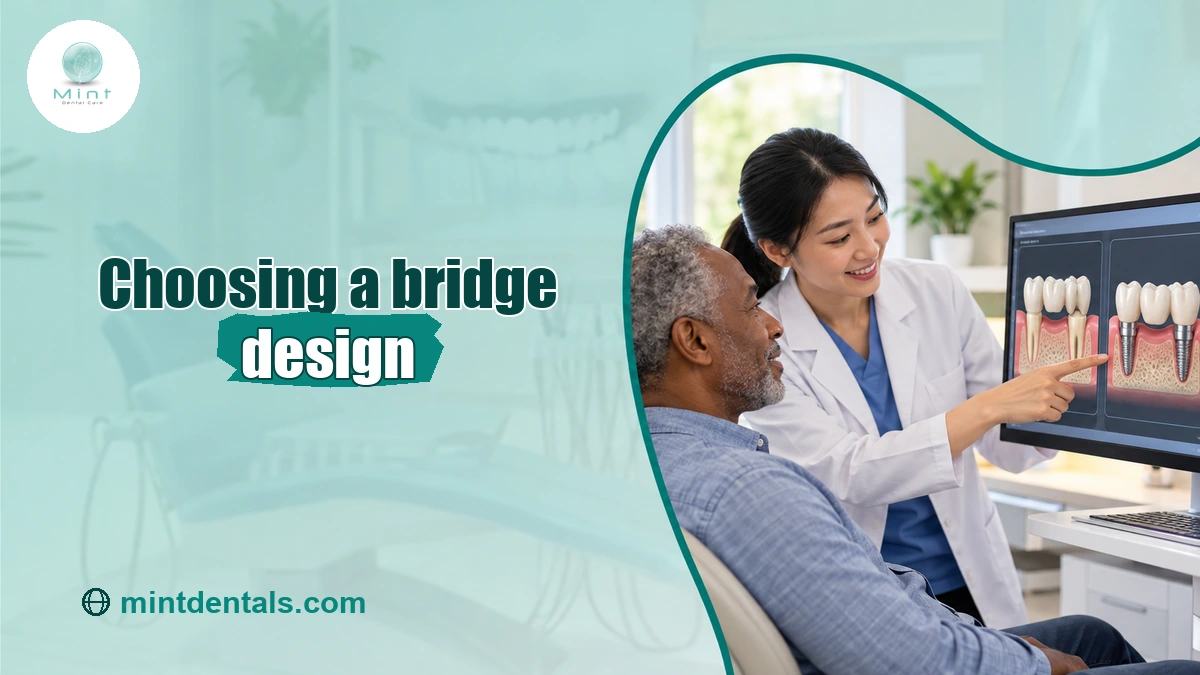
By this point the shortlist is usually down to two, and the choice between them is made from findings rather than from preference. What an examination measures, and what each route is priced at, is what turns a shortlist into a plan.
What the examination decides
An X-ray at AED 150 and a specialist consultation at AED 300 show the bone level, the state of the neighbours and how your bite closes. A prosthodontist in Dubai plans the tooth fix bridge from those findings, not from preference.
Bridge units at AED 1,500 to 3,000
A bridge is priced per unit at the crown band, AED 1,500 to 3,000 per tooth, so a three-unit span is three of those: AED 4,500 to 9,000 by that arithmetic. The band is the same for every material, as our dental service prices page sets out.
Implants at AED 6,000 to 9,000
Choose the implant-supported route and the implants are priced separately at AED 6,000 to 9,000 each, with units on top at the same per-tooth band. That is why this tooth fix bridge design is most often ruled out on budget rather than biology.
Pick the tooth fix bridge that costs you the least healthy tooth while still carrying the load where your gap sits. A single front gap usually points to a Maryland, one molar to a fixed span or an implant, two in a row to implants. Bring your X-rays and ask which teeth will be drilled.
Frequently Asked Questions
The questions below are the ones asked in the chair once a design has been named: how the four differ in anchorage, which spares the most tooth, how far a span can stretch, and which one is likely to let go first.
What are the four types of dental bridge?
The four tooth fix bridge designs are the three-unit fixed bridge, the cantilever, the Maryland resin-bonded bridge and the implant-supported bridge. They are separated by anchorage: two crowned teeth, one crowned tooth, bonded wings, or implants in bone. Material and shade come after the design is settled.
Which tooth fix bridge design prepares the fewest healthy teeth?
The implant-supported bridge prepares none, because implants carry it rather than your own teeth. Among tooth-supported designs the Maryland is most conservative, needing only a light roughening of inner enamel. The cantilever prepares one tooth fully and the three-unit fixed bridge prepares two.
Is a Maryland bridge strong enough for a back tooth?
Usually not. Molars carry the heaviest bite force, and a Maryland is held only by adhesive over a small area, so wings there tend to debond repeatedly. Maryland bridge teeth suit single front gaps with a light bite and sound enamel either side.
When is a cantilever bridge the right choice?
When there is usable support on one side of the gap only and the load is modest. A missing upper lateral incisor next to a strong canine is the standard example, as is the last tooth in an arch. The abutment needs long roots and healthy gums.
How many units can one bridge span safely?
Three units, meaning one missing tooth, is the reliable case on natural teeth. Four can work when the abutments have good root support and the bite is favourable. Beyond two missing teeth in a row, flexing and the support rule push the choice towards implants.
Why do Maryland bridges come loose?
Because retention depends on an adhesive film rather than the shape of a prepared tooth. Grinding, a deep bite, saliva contamination during bonding, or wings placed on filled enamel all weaken the join. One wing then lets go and the bridge comes off whole.
Which design fails first, and how does it fail?
The Maryland tends to fail soonest but most gently, by debonding. The cantilever follows, through loosening or fracture of its single abutment. A fixed tooth fix bridge lasts longer and fails invisibly, with decay at a crown margin. Implant-supported bridges last longest and usually need component replacement only.